New Flophouse Address:

You will find all the posts, comments, and reading lists (old and some new ones I just published) here:
https://francoamericanflophouse.wordpress.com/
Showing posts with label Osaka. Show all posts

Friday, August 4, 2017

The Cat Cafe

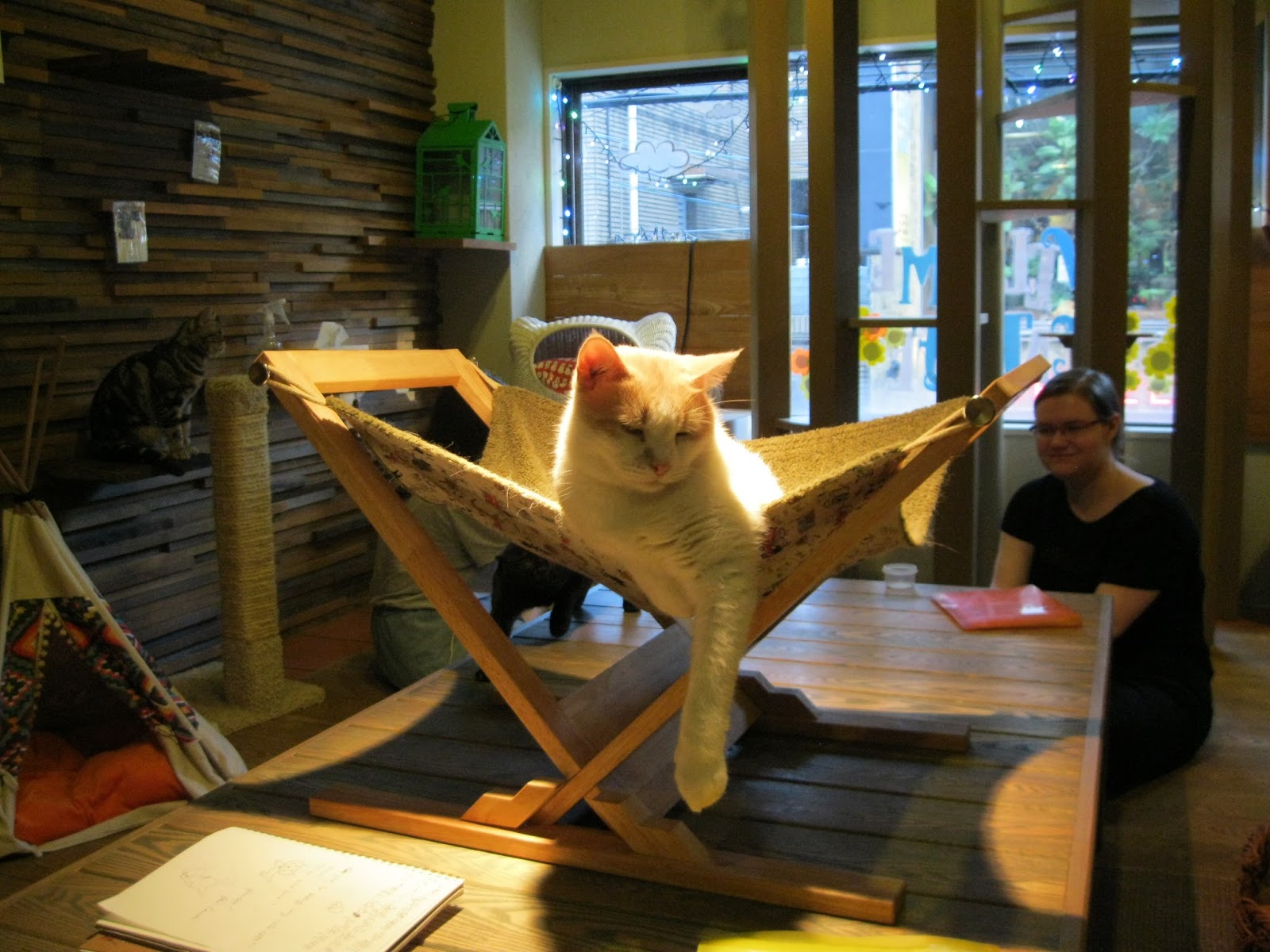
Oh, what we do to please our children.  The Frenchlings shanghaied their mother into taking them to a Cat Cafe.  Damn it,  I have cats and they are ungrateful little kibble gluttons.  I sure don't need to pay 1200 yen for an hour with someone else's fractious felines. Even if I am bribed with Mango Milk.

We went.  I drank the milk (but not the kool-aid) -  it was just as silly as I imagined it to be (grumble, grumble, grumble).

But a few minutes into the experience I started to relax.  I will even admit that maybe I enjoyed myself. The cats were remarkably well-behaved.  (Well, except for the one that was in heat and was acting like a shameless hussy though the boys were having a fine, if frustrating, time.)

And they were cute.  And that, mes amis, is why we keep the little critters.


Wednesday, July 26, 2017

The Festival of the Gods

Last night I met the younger Frenchling at work and we walked for a time with the gods.

Yesterday was the Osaka Tenjin Matsuri festival.  It starts at a local shrine with a procession through the city streets.  There were dancers in Heian era costumes, Shinto priests on horses, and mishoko, portable shrines that carry the gods.  At the river they piled into barges and the procession continued up and down the river. There was one boat that resembled a penteconter and it fascinated me because it was powered by master oarsman who could turn on a dime.    A spectacular sight.

According to the Japan Guide: "Tenjin Matsuri is the festival of the Tenmangu Shrine and honors its principle deity Sugawara Michizane, the deity of scholarship."

How fitting, I thought.  And if I had not already given my heart and soul to the Lady, this is one deity I would be honored to serve.

Here are a few pictures:


Monday, June 26, 2017

This City Was Made for Walking: The Higashi-Yokobori River

Osaka is flat and I mean FLAT.  It's great for walking or bike riding.  As I mentioned in an earlier post it's hard to get lost if you know more or less where the canals and rivers are.

http://www.suito-osaka.jp/suito/en/projects/projects.html
This morning I set out early and followed the Higashi-Yokobori River all the way up to Nakanoshima Park where the Okawa River meets the Tosabori and Dojima Rivers (no. 9).  As you can see from the map the waterways in central Osaka form a square.  Once upon a time there were smaller canals within the square and merchants could move their products around or out of the city.  I read that most of the canals were gone by the late 1960s but there are still many small businesses and warehouses in this area though goods are now moved by truck.

The Higashi-Yokobori River route must have really been something in its day.  Every few blocks there are small bridges - some of them quite beautiful.  Alas, someone decided years ago that this was the perfect place to put an elevated freeway.  What was a nice tree-covered promenade along the canal has been closed off to the public and is untended along long stretches.  What a darn shame. The city has projects for improving it (Aqua Metropolis Osaka) but I think the freeway isn't going anywhere unless nature intervenes.  I sure wouldn't like to be anywhere near it during an earthquake.   Remember Kobe?

http://www.earthguide.ucsd.edu/earthguide/imagelibrary/earthquake1.html

Here are a few pictures from this morning.  There is a happy ending to the walk - another beautiful rose garden.

The pylons for the freeway are sunk into the middle of the canal

One of the many small bridges over the canal

An old house surrounded by apartment buildings
 
More pylons and still water

And finally here is where the canal meets the rivers.
 
And here is the happy ending - the rose gardens at Nakanoshima Park

 
But the freeway continues....

Sunday, June 18, 2017

The Twilight Express

I was awake at 5 AM this morning thanks to the crows.  One bowl of Honey Nut Cheerios in me and a cuppa coffee in front of me, I am easing into the morning.  Having finished my morning reading, I'm ready to write something that you can peruse over your breakfast.  This one is for my stepfather, the man in my life who has a passion for trains.

The Japan Times reports that the new Twilight Express Mizukaze, a luxury sleeper train that leaves from Osaka, is finally on the track and taking passengers.  "The train accommodates only 34 passengers in 16 rooms. A one-night tour with a room for two costs between ¥250,000 and ¥1.25 million ($225 and $11,300), with suites starting from ¥750,000."

The last time I saw a train this luxurious it was parked in Train World, a train museum in Brussels. Just goes to show you how little I know - luxury trains are not solely a 19th/early 20th century form of elite travel.   This site has a list  of  elegant 21st century train travel possibilities from the Al Andulus in Spain to  the Tsars Gold Trans-Siberian (China, Mongolia, Russia).  Pick one at random and dream a little on a Monday morning.

And then, if you like, you can go to the Twilight Express website and watch their video (a nicely done advertisement). But, personally I much preferred  this bit of reporting from Japanese television (February 2017) which not only takes you on two tours of the interiors of the cars but has reactions and commentary.  You don't need to speak Japanese to share in the appreciation and pleasure.  Enjoy.


Friday, June 16, 2017

Osaka: Utsubo Park

"Osaka is notorious for its lack of green, quiet spaces."

Osaka’s west side story by Eric Johnston, Japan Times, 2004

Indeed, Osaka is a pretty gritty city.  Think commerce and industry.  Think working-class.  Walk down almost any street here and count the small warehouses and mom and pop businesses.  Go for a run or walk in the early morning and expect to share the sidewalk with people headed to work.  Drive a friend to the international airport KIX and pass by industrial scenes worthy of a Mad Max movie.

In Paris I orient myself around the metro stations.  In Osaka I use the canals.  This map of my neighborhood is from the Meiji period and, yes, the canals are still there as are many others around the city.
1877 (Meiji 10) Map of Osaka: 1. Nagahori; 2. Shinsaibashi; 3. Dotonbori; 4. Ebisubashi from http://www.oldphotosjapan.com/photos/82/dotonbori-ebisubashi#.WUMH6GjyjIU
Is Osaka a beautiful city?  Not if you're looking for old architecture. Old Osaka and her inhabitants were heavily bombed by the United States (my country of origin) in 1945 and once they put out the fires and buried the dead, this is what was left:

https://fr.wikipedia.org/wiki/Bombardement_d%27Osaka
But they rebuilt and the result is an interesting city.  I run and walk the streets here at all hours and I am never ever bored.  People nod and say "Good morning."  They seem amused by this middle-aged American out running in the heat (or the cold). And I in turn watch them.  The very attractive and well-muscled young Japanese man bidding farewell and bowing to a a lithe and lovely lady of the evening.

And then there are green spaces which are all the more magnificent for being relatively rare.  There is Osaka Castle, Nagai and Nakonoshima parks and there is not a week that goes by where I don't walk one of them.  And, finally, there is Utsubo Park which is a jewel with trees and paths and a rose garden so beautiful that it breaks my heart. Here, too, its existence owes something to an earlier, deadlier time:  it was constructed on the site of a former U.S. army airfield.  Today, it is quiet and green and has fountains and streams. 

I will leave you today with a few pictures of my last visit.  Bon weekend, everyone.


Thursday, July 7, 2016

Survey: Calling All Native English Speakers Residing in Japan

And I have been a very busy woman these past few months.  Graduate school is taking up most of my time.  I wrote and submitted my papers for the first term and not only did I pass but I did very well.

Once that was done I started working on my Masters dissertation.   I am doing my research here in Japan and I have put together a short survey of native English Speakers living in Japan.

If you are a native English speaker who happens to live here in Japan, I'd be very grateful for your participation in my survey.  It's pretty short and most folks can complete it in under 5 minutes.  The survey is completely anonymous and you can skip any questions you don't like.

And, if you participate and send me an email with your email to vmf2@kent.ac.uk,  I will share the results of the survey with you once the survey is closed.

Here's the link:

Native English Speakers Residing in Japan


Please feel free to share this link as widely as possible.  I am sure there are forums, blogs and websites out there that those of you who have lived in Japan much longer than I know well. :-)

Take care, everyone, and I hope to get back to posting again real soon.

Bises,

Victoria


Sunday, February 7, 2016

The History of Japan in 9 Minutes

This very strange video was passed along to me by Arun over at Arun with a View .  And I thank him for thinking of me and saving me from reading yet another academic article for seminar on what should be a day of rest and relaxation.

I watched it a few minutes ago and I think I liked it.  It does cover the major events and, as a general overview of Japanese history, it's not bad.  On the other hand there were a few places where Wurtz was trying to be amusing and I was not laughing.  At all.

No expert on Japanese history am I - it is the younger Frenchling who aspires to be a scholar of that and the Japanese language.  Of all the books that I, the non-expert, have read about Japan, the one I liked the best was Patrick Smith's Japan:  a Reinterpretation.

Here is the video for your viewing pleasure and I would be very interested in hearing what you think of it.


Thursday, September 17, 2015

Some Statistics on Foreigners Entering Japan

"Everyone is entitled to his own opinion, but not his own facts."

Daniel Patrick Moynihan


What a delight to find the website for the Statistics Bureau of the Japan Ministry of Internal Affairs and Communication which has an entire webpage with links to easy to read Excel spreadsheets in Japanese and English with information about Japan's population including the foreign population in Japan and the number of Japanese living abroad.

Why was I so happy to find this?  Because I made an assertion about the diversity of the foreign population here in Japan a few posts back.  That was an opinion (also known as a guess or a feeling) because when I was writing I had no data on hand  to back up my argument. So allow me to stop being lazy and let's look at some facts.

At the bottom of the Statistics Bureau webpage is the spreadsheet Foreigners Who Entered Japan by Status of Residence in 2013.

Most of the foreigners who entered were (no surprise here) temporary visitors or tourists.  But there are 27 other visa categories, which gives you a pretty good idea of why these migrant/expats came to Japan.  The data is broken down by region (not country) so you can see things like how many Asian diplomats versus European or South American diplomats, how many professors from Africa versus Oceania, and how many inter company transfers from all regions-

I will let you peruse the spreadsheet at your leisure, but here are a few things I found noteworthy:

Asia:  11 million foreigners entering Japan and most arrived from other parts of Asia:  nearly 9 million people from China, Korea and other parts of Asia of which over 7 million were temporary visitors.  That is 8 times the number of foreigners entering from North America and Europe (both at about 1 million).  

What are the top 5 visa categories (excluding temporary visitors and long-term/permanent residents) for Asian nationals coming to Japan?

College Students (246,853)
Exceptional Permanent Residents (134,506)
Spouses or Children of Japanese (131,814)
Specialist in Humanities (126,441)
Dependents (107,884)

North America:  Slightly over a million people from Canada, Mexico and the US of which 800,000 were temporary visitors.

What are the top 5 visa categories (excluding temporary visitors and long-term/ permanent residents) for North American nationals?

Specialist in Humanities (15,756)
Spouses or Children of Japanese (14,410)
Instructors (10,304)
Dependents (9,226)
Entertainers (7,863)

Europe:  A little under a million of which 820,000 were temporary visitors.

What are the top 5 visa categories (excluding temporary visitors and long-term/permanent residents) for European nationals?

Entertainers (16,409)
Specialist in Humanities (14,700)
Spouses or Children of Japanese (12,762)
College students (11,456)
Dependents (9,909)

Three categories make the top 5 for each region:  Children and spouses of Japanese, Specialist in Humanities, and Dependents (spouse and children of a resident with a working or student visa).  A lot of marriage migration/family reunification from all regions. 

What is a Specialist in Humanities/International Services?  It's a very broad category.  This site has these definitions:  "working in legal, economic, social fields or in the human science" and it requires a university degree or 10 years experience and "working in translation, interpretation, language instruction, public relations, international trade, fashion design, interior design, product development." This category excludes engineers, lawyers, interns, professors and doctors, 

What is an Instructor?  That was a category that made the top 5 only for North Americans. This is the category for "Instruction of foreign languages or other education at elementary schools, junior high schools, high schools, etc."  So these are language  and school teachers.  But interestingly enough there were more North American language instructors  (10,304) than there were college students (6,846).  There was one category, however, where North Americans made a greater contribution of human talent compared to the other regions:  Legal and Accounting Services (615 and no other region came close to that number).

Why so many Entertainers from Europe and North America?    I have no idea and could not find any answers on the Net.  Does anyone know what that's all about?

And last but not least what about those company expats?  Here are the numbers of Intra-company Transfer visas for each region:

Asia:  34,423
North America:  6,726
Europe:  9,351

Sunday, August 30, 2015

Push or Pull?

My Finnish neighbor here in Osaka has a most interesting blog which I follow and read daily.

This morning she wrote a post about how we met and how it is probably not by chance that we ended up in the same building in the same neighborhood of the largest city in the Kansai region of Japan. Here is a link to her post:

Coincidence?  I don't think so.

There are not a lot of foreigners in Osaka.  Most gaijin in the area settle in Kobe or Kyoto.  So a reasonable question to ask is:  Are foreigners pushed to live in Kobe/Kyoto (instead of Osaka) or are they pulled?

Not long after we arrived in Japan a long-term foreign resident told me a story which may or may not be true but supports the Push theory.  He said that for many years foreigners were  actively discouraged from living in Osaka and instead were gently herded down the coast to Kobe.  But in recent times that changed (he had no idea why) and Osaka gradually became more foreigner-friendly - though most still settle in Kobe, which has more services for foreigners and even an International Center, and in Kyoto.  The nearest US consulate, in fact, is located in Kobe, as is the American Club.  The nearest French consulate is in Kyoto.

On the Pull side note that the US military had a presence in Kobe up until the mid to late 1970's.  I met a man in Paris last year who, when he heard I was moving to the Kansai, reminisced about the time he spent recuperating in a military hospital in the Osaka area after he was badly wounded in Vietnam in the 1960's.

So it could be that Kobe was and still is a magnet for foreigners because there was an existing foreigner-friendly infrastructure already in place (the military left and the civilians took over what remained) and the local Japanese population had decades to get used to foreigners and their odd ways.  New arrivals may have been attracted to that city because there already was a foreign population and infrastructure there which made it easier to form networks, make friends, find compatriots (or other "internationals") and ease into life in Japan.

My sense is that there is both Push and Pull operating here with the scales tilting toward Pull.  Osaka is not the most attractive city in the Kansai (though it is the largest), and much of it was destroyed during WW II and rebuilt so there is very little that is old and charming.  Kobe and Kyoto are a mere 20 minutes away from Osaka via fast train so it's not unusual for families to live outside the city while the salaryman commutes morning and evening. In addition to being more foreigner-friendly, I'd say both cities are more family-friendly.

I'm sure there are other factors that I am unaware of and this is just a rough sketch based on what I have learned so far.  What I am sure of based on my migration experience elsewhere is that wherever I land, I am inserted into a moving river.  To understand the temperature of the water and the strength of the current that pushes and pulls in different directions, I must look to what and who came before me.

********************************************
And just for fun, and because I am riffing off a post written by my neighbor in Japan, here is an old Flophouse post that talks about The Neighbors I have Known in France.


Friday, July 10, 2015

Paris Syndrome

In an hour or two Mr. Clement (our trusted taxi driver) will pick us up and take us back to the Worst Airport in the World (CDG).

Our time in the Hexagone was short - less than two weeks - and it was stressful.  The purpose of the trip was my 6-month checkup at the cancer clinic complete with my annual PET scan and a consultation with my oncologist.  The tests were ghastly.  Nothing like taking the train into St. Cloud with jet-lag and on an empty stomach in order to be poked with needles, shot through with radioactive liquid sugar, and then placed into a slim tube and told not to move a muscle for 20+ minutes.  To my horror they stopped the test right smack in the middle and two techs came in, flipped back the blankets and carefully examined my right side (the area where the tumors and my lymph nodes were removed back in 2012).  And then without a word to me they left and started the machine up again.  A few minutes later we were done, they fed me breakfast and let me go.

The experience was unsettling and I spent the next week swinging between anxiety attacks and depression.  Was this due to the stress of waiting for my test results or did I have a touch of Paris Syndrome?

Paris Syndrome (Pari shōkōgun) is a term coined by the Japanese to describe "a transient psychological disorder exhibited by some individuals visiting or vacationing in Paris or elsewhere in Western Europe. It is characterized by a number of psychiatric symptoms such as acute delusional states, hallucinations, feelings of persecution (perceptions of being a victim of prejudice, aggression, or hostility from others), derealization, depersonalization, anxiety, and also psychosomatic manifestations such as dizziness, tachycardia, sweating, and others  Similar syndromes include Jerusalem syndrome and Stendhal syndrome. The condition is commonly viewed as a severe form of culture shock."

Going from Osaka to Versailles is a shock to the system, no doubt about that.  The first impression I had as the taxi drove me from CDG to my home was how dull and grey and dirty France was.  The sun doesn't shine as bright as it does in the Kansai.  As the taxi darted through Versailles' small streets, the people I saw who were walking briskly going about their business never seemed to smile and on the surface they looked to be deeply unhappy.

Those impressions remained with me even after the jet-lag was gone and my tests were behind me.  Even the unusualy warm weather didn't help - I was cold much of my time here in spite of the 35+ degree weather.  One antidote to all this was to work on my house and garden.  The best therapy, I say,  is getting one's hands dirty digging weeds and pruning roses.  The other was to knock out the last of our house projects:  the rotting front porch.  The workmen removed it just before we arrived and they stopped by and installed the new wooden bannisters a few days after my tests.


A week after the tests we trekked over to the clinic for the consultation with my oncologist.  As tired and disheartened as I was about France, I was definitely not yet tired of life because when my oncologist announced that my tests were fine and they found no recurrence of the cancer  I was filled with relief which transformed itself into quiet joy as we headed back home.  And the rest of our time here was spent seeing friends and walking around the city of Versailles which now glittered so brightly and felt familiar once again.  Vacation at last.

Paris syndrome or stress and depression?  Hard to say.  Probably a little of both which was lethal for my morale.  A few posts ago I talked about the benefits of Third and Fourth Places.  This trip made me aware a that while I split my life these days between France and Japan I am also a permanent resident of a country called Cancerland.  And the last has one hell of an exit tax.

Another 6-month reprieve and now it's back to Osaka and our apartment on the 14th floor in the middle of the city with a view of the mountains.

Wednesday, June 10, 2015

The Third Place: Perspectives, Myths, Limits

For many many years my life was lived between two countries:  the United States and France.  All other places lived at the periphery of my vision;  they existed but they were not immediately relevant.  I was not interested or curious about how one might live or land a job in South America, or what it might be like to be married to a Russian a Chinese or even a fellow American.  Some choices, once made, are irreversible.  I can no longer be a person who never left her home country to live elsewhere.  I also cannot go back in time and choose another country as my first destination. For me it will always be France.

With the addition of a Third Place, Japan, and the breaking of the limited and binary US and/or France perspective, how has that changed the way I think about my past and present experience?

Three-point perspective:   With a move to France I learned that the world is much larger than just the North American continent.  With the move to Japan I see that the world is much much larger than Europe and North America.  At any time I can take a look at present and past experience from any point on the triangle:  American, long-term resident of France and short-term resident of Japan.  What does Japan look like from a French perspective?  From an American one?    In this way I can contrast and compare;  see convergences, see differences.

From an American standpoint France and Japan appear to be high-context (versus low-context) cultures.  An awful lot of what goes on in daily life in both countries has a hidden context that has to be learned over years of exposure and trial and error. Learning the language is a necessary, but not sufficient condition to be able to function in society since what is said does not necessarily correlate with what one is meant to hear or understand.   I read an argument to that effect many years ago in a book by E.T. Hall and mentally shelved it at the time as an interesting, but not terribly pertinent, proposition.   Dusting it off and looking at it again after 6 months in Osaka, I think Hall was definitely on to something.  

The act of mentally moving from one point to another on the triangle yields insights that simply can't be perceived from just one, or even two, perspectives.  I wonder what would happen to the triangle if it became a square with the addition of a Fourth Place?

Myth of uniqueness:  This, I am finding, is a very common ailment among long-term residents who come from developed countries and call themselves "expatriates."  I suffered from it for years in France and it was a huge shock to my ego when I finally met other Americans. Brits, Mexicans and other nationalities who came to France 20 years or more before I did, were also married to Frenchmen and women, and were well-integrated, worked and spoke excellent French.  It shattered my personal myth of uniqueness that held that my Hero's Journey was somehow different and that I was on the road less-traveled.  

I came to Japan with some vestiges of that (which I am not proud of).  While I was willing to concede in France that I was in no way superior or inferior to my fellow migrants/expatriates, I did start mentally positioning myself as different in relation to expatriates/migrants in Japan.  The process might have come to a hubristic conclusion if I had stayed in splendid isolation and not bothered to try and make contact with other migrants/expatriates.  It took just a few meetings and conversations with long-term  expats married to Japanese nationals to rightsize me.  Different countries and cultures?  Absolutely.  But very similar concerns, problems, and satisfactions.  Like learning a new language,  raising multi-lingual/multi-cultural children,  deskilling, cross-cultural marriages, life as the foreign spouse, immigration formalities, citizenship versus residency, the different status of men versus women in the host country.

I was stunned by how much we had in common and how much I learned from the differences we exposed to each other.  And ever since I have this fantasy where members of the Association of American Wives of Europeans fly in to Tokyo to meet the members of the Association of Foreign Wives of Japanese; or folks from the Society of Writers, Editors and Translators in Japan flying into Paris to meet their counterparts in the Hexagon.    

The limits of knowledge and experience:  A life now split between three countries and yet I realize how little I know about any of them.  Though I spent my formative years in the US, I hardly know that country at all.  I know exactly two cities (Olympia and Seattle) and one region.   As for the rest of the country, I know next to nothing about the major cities like New York or San Francisco.  People who live in the South, the Midwest, the East Coast are foreign to me.  Even if I had never left the US and decided to migrate from one region to another there is no way I would have experienced every place or met every different kind of American.

Exactly the same is true of France after 20 years living there.  I have not seen every city or every region.  I know well only a very tiny percentage of the total population.  I will never know even a fraction of the 65 million people there, nor will I ever have the chance to live and integrate into every corner and sub-culture of the Hexagon.  It is simply not possible in one lifetime.  Not even for the native citizens themselves, which is a reason among others that the notion of "Imagined Communities" is still as relevant (and troubling) today as it was back in 1983 (the year I graduated from high school).

So I approach Japan with the recognition that however long I stay here, be it 3 or 30 years, I will never know everything there is to know about this country just as I don't know everything there is to know about France or the United States.  There will always be blanks and blind spots behind me wherever I go;  places I could have gone and people I might have met.

It took arriving in a Third Place for me to come to the rather humbling realization that if the world is a library, then I will only ever read a limited number of volumes.  I don't necessarily find that discouraging.  In my middle years I have learned that progress is all that is required, not perfection; and that life is always manageable and deeply satisfying if I just take it one book and one country at a time.

Monday, June 8, 2015

Izumisano Fish Market

Sunday morning the other residents of the Flophouse in Osaka wheedled me into a trip to Izumisano Fisheries Cooperative Open-Air Fish Market out near the Kansai airport.  Resistance was futile and after fortifying me with lots of coffee and last night's tempura take-out, they finally got me out of the house and into the car by noon. 

"What's the big deal," I thought. "I'm from Seattle which has the coolest fish market around."  So cool that it gave me right to be snooty about the Paris area which has no fresh fish markets worthy of the name.  

"And we have to drive out there," I grumbled.  Oh, the horror.  Actually, given the way my French spouse drives it is pretty horrible.    Ever see the way French drivers spin around the rond-point of the Arc de Triomphe at high speed cutting off other cars and flipping everyone off?  Like that.  He drives like that in Osaka.   When (not if) we are stopped by a Japanese traffic cop, I have a sad tale all ready to tell about how this dumb Americaijin was suckered into the car by this devious driving demon from Furansu.

The Izumisano fish market was worth it.  The market itself is on the ground floor and is small enough to feel cozy and not overwhelming.  The fish were so fresh that some of them were still twitching on the ice upon which they were so carefully and artfully laid.  Prices were good, too.  10 gambas (big shrimp) for 1,500 Yen (about 10 Euros).    


We asked the younger Frenchling to select a fish for her Going Away Dinner (she leaves this week).  We think it's tuna.  No matter because when in doubt I just use the James Beard method for cooking fish.  Works every time.


And to expiate his driving sins, we made the Frenchman clean it.

Next to the fish market is the marina with the Japanese fishing boats tied to the dock.  It was quite a sight - I had never seen one up close. 


A couple months ago the remains of a Japanese fishing boat was found floating off the coast of Oregon, USA near Ona Beach.  NPR reported that the vessel was one of many that cut loose and were lost after the 2011 earthquake and tsunami.  There it was four years later on the US West coast "carrying a small diaspora of live yellowtail jack fish, native to east Asian waters..."

The remains of the boat, they said, were to be brought in to port and identified.  No mention, however, was made of what happened to the travelers after the biologists determined that "the attached organisms pose little threat to the Oregon coast ecosystem."  

The attached organisms?  They are called "fish," folks.  And I sincerely hope that someone had the good sense to take nature's bounty (the flip side of nature's wrath) home as we did this weekend and cook it up for dinner.

Wednesday, June 3, 2015

Osaka: A Great Place to Get a Tattoo

When we were visiting Nara the other day, we stopped for a picnic lunch in a local park.  As I was chatting with one of my spouse's Japanese colleagues about her time in LA over some really awful white bread sandwiches, the conversation suddenly stopped dead..  I looked up and this nice young lady (and her little dog, too) was staring at the tattoo on my leg. "You have a tattoo!"  she exclaimed.

Well, yes, clearly I do, miss, because you are looking right at it. (And the young think us oldsters are slow.)

Feeling both perverse and amused, I rolled up my pant leg and gave her the full view.  And then I pulled my shirt off my shoulder and showed her the other one (my bluebells).  "Look, mom, TWO tattoos."

No, I didn't say that (but I wanted to).  Then the younger Frenchling got into the act and showed off her glorious cherry blossoms which run from her shoulder to the center of her chest.  We were having a fine time and then I went a bridge too far.  I turned to my spouse and said, "And he has..."

At which point my spouse (her boss) gave me a glare that said that right now would be a very good time for me to shut up.  So I did.

I have not been in Japan long enough to understand all the cultural baggage around tattoos.  The reactions I've seen range from horrified fascination to "So what."  I do know that places like public baths can refuse people sporting ink.  Has to do with organized crime, I hear.  I'm sure that some Flophouse Japanese near-native reader can clue us all in.

Some families have shared interests like camping, hiking, books, drawing each other's blood over the dinner table.  Our family gets tattoos.  We all have them (even Mr. I Am Gainfully Employed) and most were done in Seattle.  Mine were done at Two Birds Tattoo and Super Genius.  The latter had one artist, Ashley, who has become a favorite of the Frenchlings - she does amazing work.

So trust the Frenchlings to find a tattoo place in Osaka.  It's called Three Tides Tattoo and it's about a 20 minute walk from our house.

Last night we leisurely strolled over to that side of the neighborhood and walked into their studio.   I installed myself downstairs on a comfy window seat and the younger Frenchling bounced upstairs to get her fourth (or is it fifth?) tattoo.


Very nice.  So nice that her mom intends to go back for a consultation.  There is this scar, you see, that marks the spot where the chemo shunt was inserted and later removed. It's not pretty.  Not that I need an excuse, mind you.    This body of mine went through the cancer wars and emerged in its present state.  After everything that was done to it, what joy it gives me to have bright colors and pretty patterns imprinted on it by choice.

I am mindful of the cultural associations that go with tattoos - be they images of bikers, prisoners on parole or yakuza - but I don't lose any sleep over them.  As a former foot soldier for international capitalism, I learned a lesson long ago that the really Bad Elements don't advertise evil affiliations and intentions with tattoos or piercings or  baggy pants.  Sometimes they show up wearing suits and ties.

Saturday, May 30, 2015

The Earth Moved

About an hour ago as my daughter and I sat in the blue chairs reading and my spouse was watching his evening action movie, our 28-floor apartment building began to rock back and forth like a big creepy cradle.  The dining room ceiling light swayed.

"Earthquake,"  my daughter said.  And we all looked at each other and hung on for the ride which seemed to go on and on and on.

Low in intensity; but long in duration.

It finally stopped and we all leapt up and grabbed our me-machines to find out what the heck had happened and where.

A 7.8 and the epicenter was out in the Pacific Ocean (south of us).  The Japan Meteorological Society website has this map showing where it all began at 20:24 (x marks the spot).  Note that by the time it arrived chez nous, it was a 2 or 3 (maybe even a 4).

We were hardly alone in being jolted out of our evening routine.  This graphic from Fark Japan Quake map shows just how far and wide this one was felt.


Monday, May 18, 2015

Nara: Buddhist Temples and Shinto Shrines

This weekend one of my spouse's colleagues took us on a tour of her hometown:  the city of Nara.

Nara is located in the Kansai region and and was Japan's imperial capital from 710 to 794. In 794 the emperor/empress moved to Kyoto but the many temples and shrines remained.   It's a city every bit as magical as Kyoto and we had a fine time walking in Nara park, feeding the deer, and visiting the Kasuga shrine (Shinto) and Tōdai-ji temple (Buddhist).

In the modern Christian countries I know best in Europe and North America there are many debates about the role of religion in society, and between atheism (there is no God) and monotheism (there is one God).  There is another, older ism and that is polytheism which posits that there are many Gods and Goddesses.  As we strolled through Kasuga I asked our guide to explain something about Shinto, a religion that was not part of the curriculum at my Catholic high school (though Buddhism was).


She confirmed that there were indeed many gods in the Shinto pantheon but there was a hierarchy with some gods being more powerful than others.  When she was a child, she said, there were several shrines in her parent's house to which she brought offerings.  Not so common today, she noted, but important life events are still marked by a visit to a shrine to, for example, present a newborn child for the priest's blessing 30 days after the birth.


Though I thought I would be on firmer ground at the Buddhist temple Tōdai-ji, I was soon confronted with just how little I knew about it.  Buddhism has many different schools with subtly different philosophies. Tōdai-ji is the center of the Kegon school of Buddhism in Japan. And I should note here that there is another ism that I should add to my previous list and that is nontheism.

 Buddhism is, in my mind, most definitely a religion but one that has "no reference to such a singular, personified deity."   But "If we interpret the nature of gods, small ‘g’ and plural, or divinity even more broadly conceived as a sacred basis of reality, then certainly Buddhism has much to say on this matter."

Walking through the Kasuga shrine and Tōdai-ji I found that "sacred basis of reality". There were many things that felt comforting viewed from my own religious tradition, Catholicism.  The use of water, for example, to purify oneself before entering a holy place; the use of fire - the votive candles lit by believers and laid around the statue of the Buddha Vairocana; and, of course, the many monks and priests in their special garb.

As we left I was stung with regret that I did not have a better grounding in either religion.  Like a cathedral, everything in a temple or shrine has a pedagogicial purpose, but I didn't know enough to be teachable.  I could only admire and speculate.

But ignorance, once diagnosed, is curable, and I like what Thomas Merton had to say about studying other traditions:  "The Christian scholar is obligated by his sacred vocation to understand and even preserve the heritage of all the great traditions insofar as they contain truths that cannot be neglected and offer precious insights into Christianity itself".

Wherever I go in the world I carry a rosary in my purse that belonged to my great aunt and I often wear a medallion around my neck with a picture of the Lady (the Blessed Mother).  To this collection I have now added a Shinto shrine charm - a talisman called omamori that, according to our guide, confers protection against bad luck or evil events.

At Tōdai-ji the younger Frenchling made an offering for a ceramic tile - one on which she was asked to write her name, the date and a desire, and will be used to replace a damaged tile on the temple roof.


And what was her request?  Her wish? Her heart's desire?

To one day publish a book.


Tuesday, April 28, 2015

Another Glorious Day at Minoo Park

Apart from my personal (un)dress fiasco, Sunday was another wonderful day at what I think is Osaka's most beautiful park.

Last time I was there it was the middle of winter and I still enjoyed every minute of it.  With better weather, it was a nearly perfect experience.

The trail is about 2.5 kilometers with a gentle gradient going up to the waterfall and in summer 90% of it is under the trees and in the shade.  There is something on the trail for everyone:  the culture vultures can admire the temples and shrines, the foodies can eat at one of the many restaurants and cafes, and the nature lovers can concentrate on the stunning scenery and malicious monkeys.  Just a little downstream from the waterfall, the river is calm and shallow and there were children happily splashing around in the water and climbing over the rocks under the eyes of their parents and grandparents.

Minoo Park is a perfect outing for families, couples, lovers, seniors - it's a park that is accessible to - and has something for - just about everyone. (And it's free.)

So, if any of you folks ever show up to visit the Flophouse here in Osaka, guess where we will be going?  A trip to this park is not optional; it's required of all guests.  I hope that expresses just how much I love it and want to share it with visitors.

Here are a few pictures from Sunday.  Enjoy.