New Flophouse Address:

You will find all the posts, comments, and reading lists (old and some new ones I just published) here:
https://francoamericanflophouse.wordpress.com/
Showing posts with label France. Show all posts

Friday, June 9, 2017

Macron Makes a Move to Attract Talent to France

https://twitter.com/EmmanuelMacron/status/870407981044834304/photo/1
Tim Smith sent me a link today to a new website meant to attract highly-skilled migrants to France. The title of the website is a riff off the US President's slogan "Make America Great Again" and it implies that Trump is a provincial person who doesn't care about the rest of the world and who has abdicated any claims to US leadership in this international fight against global warming. Very deft. Here's the link (and after reading the home page who wouldn't click on it if only out of curiosity).

Make Our Planet Great Again

It's well done.  Very VERY well done.  What makes it so in my eyes?  The first is the impeccable timing.  This is the right moment to strike when Americans are reeling over the US withdrawal from the Paris accord.  I'm amazed that they got it up so fast and coordinated it so well with a social media campaign which says to me that Macron has a very competent and well-organized communication staff.  The personal pitch itself is inspiring:  "We are ONE planet and Together, we can make a difference."  And it extols the virtues of France and positions her as a leader in a winnable fight for the planet. "France has always led fights for human rights. Today, more than ever, we are determined to lead (and win!) this battle on climate change."   And then at the bottom of the page is a big clickable field entitled "I want to make the planet great again."

After  Macron's pitch the site gently guides the potential migrant/expatriate interested in working on climate change though a series of open and closed questions.  I use the word "gentle" because none of the questions are complicated or require detailed information.  They don't ask about degrees or experience.  There's just a drop-down menu on the first page that asks if you are a researcher/teacher, entrepreneur, student, NGO worker, or other. And then a second field that asks what country (and in the case of the US, what state) you come from.

This is followed by open fields where you answer questions like "I'm fighting climate change because...," "I currently work on....," and "My dream is to..."  That's a rare chance for a potential migrant to make his/her pitch in his own words.   Nice.  And the final page takes you straight back to Macron's pitch for France, "Your new Homeland." And finally there is a big clickable button on the bottom of the page that says, "I'm coming to France."

Wow.  Talk about casting a wide net.  Talk about mad communication skills.  The other countries competing for the highly-skilled should take note.  I think it's better than 5 Reasons to Work in Sweden which I already thought was pretty good.

Have a look and tell me what you think.

Sunday, April 30, 2017

No Fear

This Canal+ March 22 interview with Fatou Diome is a beautiful response to the proposed policies of the French presidential candidate Marine Le Pen of the Front National.  It is making the rounds of francophones on social media.  I post it today on the Flophouse because it is so eloquent and because she's right and not only about France:  Le Pen and her supporters are afraid, just as some Japanese are afraid of Koreans, some Americans are afraid of Mexicans and so on.  Fear of the Other (and espcially the Other that moves around the world) is everywhere.  Watch the entire interview.  It's brilliant.


Fatou Diome : "Vous avez peur de Marine Le Pen... 投稿者 legrosjournal


Sunday, January 18, 2015

Charlie Hebdo

My personal reaction to the events that rocked the Hexagon recently has been to avoid the media reports domestic (France) or foreign (the US and others).  Alas, the media reached out for me which was a huge surprise.  I came home one day and a Seattle (my hometown) news radio station  had sent mail and a tweet asking me to give a live report from Paris on their morning show.  I declined.  And then they called me on my cell phone and I found myself talking to a reporter who said she just wanted a few comments.  That seemed doable (and harder to refuse with an actual human being on the line) and so we chatted for a few minutes.

In that interview I committed the great sin - I was boring.   She wanted stories of a city paralyzed by terrorism whose denizens were living in fear.  What she got was: Well, things are actually pretty normal.  The only exceptions to that that I experienced were the announcements or at the train station asking us to be extra vigilant and the locked doors at the American Cathedral in Paris which meant that you had to ask to be let in.  That was it.  Really.

And then the conversation took a dark turn with talk of 911 and an attempt to link what happened to Charlie Hebdo to US efforts against terrorism and the "Islamofacists."  That left a very bad taste in my mouth to the point where I lost my serenity and asked if she thought that Seattle was a hotbed of terrorism as well.  "They are everywhere," she replied.

After that my resolve to avoid the media doubled and I stopped even reading the headlines.  I have an instinctive distrust of any "analysis" that is made in the heat of the moment.  I am even more dubious of foreign (US) news reports that attempt to tie what happened in Paris to past events (and present efforts) in that country.  If anyone would like to make that case then I would like to see it done with humility and sober reflection and not as part of a media frenzy.  But that's not my call, is it?

Enough said on the subject.  Arun has run several nice pieces on his blog with links to other good articles and so I will again send you over to Arun with a View and his latest blog post:  Understanding Charlie Hebdo.

And this was kindly passed along by Leila on Facebook.  Here is a French news program poking fun at Fox News - it's pretty good.  Enjoy.


Wednesday, January 7, 2015

Attack in Paris

Late this morning I was at the American church and as I and a friend were walking out on the way to lunch, the staff at the church gave us the news that there had been a shooting in the 11th district and that the church was closed down - standard, they said, when this happens.  The friend I was with lives in that part of town and was on his cellphone immediately.  Quite a relief to him to hear his family on the phone.

It was a horrendous attack. I will not say more here about it because I think Arun's post is perfect and he is updating it with links and commentary as more information comes in.  I invite you to head over there and read about what happened:

I am Charlie

After I posted this I had an urge to pick up St. Augustine and find this passage.  Not sure why it inspires me but I thought I would share parts of it with you.  Eternal questions that we still struggle to with :
"Where then is evil, and what is its source, and how has it crept into the Creation?  What is its root, what is its seed?  Can it be that it is wholly without being?  But why should we fear and be on guard against what is not?  Or if our fear of it is groundless, then our very fear is itself an evil thing...Whence then is evil, since God who is good made all things good?"  


Friday, September 19, 2014

FATCA Now the Law of the Land in France

For those of you who missed the FATCA debate yesterday in the French parliament, here are the essential links:

The video of the discussion (go to the box on the right side of the screen and scroll down and click on ACCORD FRANCE-ÉTATS-UNIS D’AMÉRIQUE RESPECT OBLIGATIONS FISCALES (LOI FATCA)
The transcription of the debate

I watched it this morning and here are few of my thoughts.

First of all, I was impressed by the high caliber of the discussion. All the individuals who spoke did so clearly and thoughfully.  I heartily wish American politicans could do half as well.

Framing:  I was very interested in seeing how the pro-FATCA camp framed their arguments and addressed certain reservations already put forward in previous debates.

The larger context, of course, is the Good Fight against tax evasion and fraud.  Even Pierre Lellouche (UMP) who spoke against the law admitted:
L’objectif affiché se passe bien sûr de toute discussion. Il s’agit d’œuvrer pour la transparence fiscale et de mettre fin, grâce à la coopération des États et à la transmission automatique des informations, à la fraude fiscale massive que connaît le monde : environ 6 000 milliards de dollars qui échappent à toute imposition.
De ce point de vue, personne ne peut être contre. Comme disent les Américains, personne ne peut être contre la tarte aux pommes et la patrie, apple pie and motherhood ; tout le monde est pour ! (Sourires.) À mort la transparence !
(The objective obviously needs no discussion. It is about fiscal transparency and the end, thanks to cooperation among states and the automatic transmission of information, to widespread tax evasion in the world:  6 000 billions of dollars that escape taxes.
From this point of view, no one could be against it.  As the Americans say, no one can be against apple pie and country, apple pie and motherhood;  Everyone is for! (Smiles).  Death to Transparency!
)
Is FATCA THE Solution to Tax Evasion?  Not one speaker thought that FATCA was perfect, they simply differed as to how bad it was and whether or not these problems were deal-breakers.

Expressions of discontent peppered the debate: "extraterritorial", "unilateral"  and the rather grim indictment, "Americans have a tendency to privilege their interests over international law."  If a better, more multilateral proposition had been on the table, then that would have been preferable.  But it's not a perfect world, said its proponents, and it's better than nothing.  If nothing else it has had the salutory effect of moving other information-sharing initiatives forward (OECD, for example) which means that FATCA is just a step on the way to a true and legitimate worldwide standard.

Reciprocity is a Problem:  I was pleasantly surprised that they were aware of just how fragile the US commitment to reciprocity really is.  US law does not at the moment permit the US government to provide the same level of information to France, but the FATCA proponents did not mention ALL of the potential legal and political problems with FATCA on the US side. Mme Odile Saugues:  
Tout d’abord, il existe une incertitude sur le principe de réciprocité, et notamment sur le solde des comptes et la valeur des actifs. Les États-Unis se sont formellement engagés à transmettre ces informations dès que leur droit interne le leur permettra – ce qui n’est pas le cas à ce jour. Les élus républicains du Congrès – Rand Paul, sénateur du Kentucky, et Bill Posey, représentant de l’État de Floride – bloquent actuellement la transmission de ces données dans le cadre du dispositif... Cette situation risque de durer jusqu’aux élections de mi-mandat aux États-Unis, qui auront lieu le 4 novembre prochain.
(First of all there is uncertainty about the principle of reciprocity and especially about account balances and stock values. The US has formally committed to sending this information as soon as their internal laws allow it. Republican lawmakers in Congress - Rand Paul, Senator from Kentucky, and Bill Posey, representative from the state of Florida - are blocking the transmission of this information in the context of this law... This situation may continue until the mid-term elections which will take place on November 4.)
Interesting. To my knowledge there is no projet de loi on the American side, just a brief paragraph hidden in the Obama budget bill. Furthermore, there are court cases launched (or about to be launched) in the US and Canada which are a real risk to FATCA. The American lawsuit, in particular, should have been mentioned since it calls into question, among other things, the legality of those inter-governmental agreements on the American side - those IGAs that the French government says they were in part responsible for forcing on the US along with other European countries like Germany.  

I would also say that even if the Democrats were to win and take control of the US Congress, Americans banks and financial institutions are important campaign donors to both parties and they will surely have something to say about reciprocity on the US side.

As one speaker put it about those IGAs and American promises: "Cette rédaction alambiquée est, pour qui connaît les institutions américaines, une vaste plaisanterie, qui rappelle le vieux proverbe selon lequel, en politique, les promesses n’engagent que ceux qui les écoutent."  (This convoluted text is, for those who know American institutions, a joke, reminiscent of the old adage in politics, promises only bind those who listen to them.)  Well said.

Impact of FATCA on French Citizens and Residents: Frédéric Lefebvre was the only speaker who addressed the impact of this law on French citizens. He spoke very eloquently in defense of the French abroad, the "Accidental Americans" in France and the 100,000 US citizens who are legal residents of the French Republic. (The full text of his speech is here.) No one will weep for the tax evaders caught in the net, he said, but:  "Il faut cependant prendre garde, je le dis avec gravité, aux effets pervers du dispositif tel qu’il nous est proposé." (You must be careful, and I say this to you with utmost seriousness, of the perverse effects of this law that you are proposing." )

Frédéric Lefebvre's motion to delay the implementation (and the vote) until these matters can be studied further was voted down and the law implementing FATCA in France was approved.

Thursday, September 18, 2014

FATCA Debate in the French Parliament

Got an email yesterday from a Flophouse reader pointing out that the UMP Quebec 2014 twitter feed recently tweeted two Flophouse posts.  That was unexpected but pleasantly so.  Thank you to whoever manages that feed and I hope that those who follow it will be inspired to action.  As of this morning there are 29 comments about the US renunciation fee raise on the regulation.gov website and it would be good to have many more.  Please be aware that you can leave a comment anonymously.  That's right, you do not have to give them your name or contact information.

As I was reading the feed I noticed a note from Frédéric Lefebvre, the Député des Français d’Amérique du Nord.  If you are a French abroad in North America, he is your representive in the French national parliament.  He has been an excellent advocate for his constituents who are, alas, part of the collateral damage brought about by FATCA.  In June he met with two dual (French/US) citizens to talk directly with them about how this American legislation impacts them in France.

He says that there will be a parliamentary debate TODAY (September 18, 2014 and it's number 4 on the morning agenda) concerning the legislation that is needed to implement FATCA in France.

For those who are interested (and you are many) here is the projet de loi for FATCA that was introduced in July by Laurent Fabius and passed by the French Senate (via an "accelerated procedure").

And here is a report about the FATCA legislation prepared by Ms. Estelle  GRELIER for the Assembly which was presented and discussed by the Commission des affaires étrangères on September 10.

Hopefully the debate will be recorded and if so I will post it here on the Flophouse.

Update:  You can watch the debate en direct this morning here.

Saturday, September 13, 2014

What if?

I'm almost finished with a really good book by Alan Weisman called The World Without Us.  It's a thought experiment:  What if humans vanished tomorrow?  What would happen and would might the world look like in 10, 100, 1000 or 10,000 years?

I can't vouch for the science but it does support a suspicion I've had since I was a kid growing up in the Pacific Northwest of the US:  the human race's grip on this planet is a lot more tenuous than we think.  I was raised in the western half of Washington state which is temperate rain forest and I did a lot of hiking in my youth.  Here's a video that will give you a good idea of what that looks like:


In order for anything human-made to last,  it has to be maintained with great effort.  In a few short years, that old field or house or road starts to deteriorate.  I saw this with a plot of land that my family owned back in the 1970's - we cleared an area and just a few years later had to get out the chainsaw to clear it again.  This is not an argument for humans doing whatever they want;  it's simply a recognition that there are forces that will take back what we make, much faster than we might imagine.

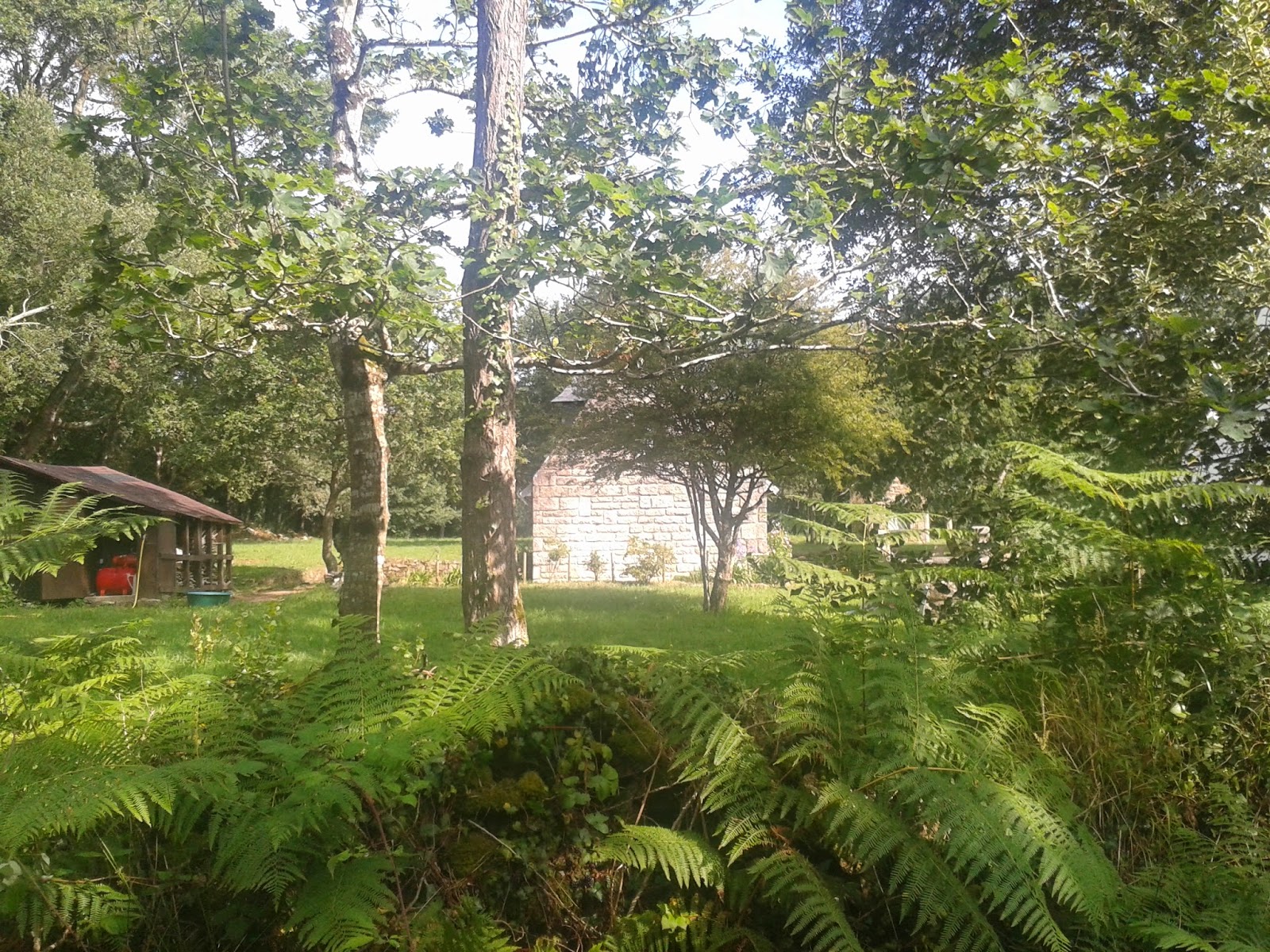
As I was reading the book and thinking about that, it occured to me that I had an even more recent example of this.  I spent part of my summer in Brittany, France where my mother-in-law owns an old fisherman's house.  I've been going to the same area for over 20 years now and what I see every time I visit is less and less land under cultivation (fewer farmers).  Some of the land was sold and there are new houses (or people trying to save old ones) but a lot of it has simply been abandoned.  In some places the only way you know that there was a farm and fields is because you'll see a little part of what was a stone wall peeking out from under the moss, ferns and trees.  Then you look closer and see that on the other side, there is forest but it's not that old (less than 100 years).  From field to forest (albeit a kind of scruffy forest with a lot of brush and shrubbery in addition to the trees) in one lifetime.  Even the stone walls, which in some places come up to my shoulder are being covered with vegetation and I've seen trees growing in these walls around those old fields, slowly tearing them down.

During dinner one evening this year we looked out the window and saw a chevreuil (European deer).  In 30 years my mother-in-law said that she had never seen one before that day.  Here's what they look like:


I really recommend the Weisman book and I'll leave you today with some pictures I took during our month in Brittany. Have a great weekend, everyone.

Old stone house which is occupied - in the foreground is the old stone wall


Four à pain (oven for baking bread).  It's not that old (probably 19th century).
The owners of this property are keeping the brush away from it but look at the roof.

Typical dirt road in the area.   You can still see the outline of the stone walls on one side.
Brush and trees growing on both sides which get hacked back to keep the road clear. If you
go off the road, wear high boots - there are snakes.

And finally, one of my favorite local spots and an example of two very old things that that have lasted up to the present day:  La chapelle Saint-Philibert in Trégunc.  It was built in the 16th century and is beautifully maintained.  The chapel however, was built next to a fountain which is ancient.  When I went one year on their annual pardon, I was told that it was definitely around in Roman times (pre-Christian era) and may date to earlier than that.


Friday, February 7, 2014

Axa Banque - U.S. Person Account Closures in France

It's official, Axa Banque sent letters out recently to their U.S. Person clients informing them that they are no longer welcome chez eux and giving them very little time to find alternatives.

This has hit the French news.  Le Figaro had this article by Anne de Guigné: Axa Banque ferme les comptes de ses clients américains.  Unfortunately, it's only available to subscribers so let's turn instead to another one that was published yesterday in Le Point:  Axa Banque ferme les comptes de ses clients américains en France !

In both articles the ejected clients of Axa Banque who are cited are, in fact, French citizens.  They are what we call "Accidental Americans" - they were born in the United States but have always considered themselves to be 100% French. To their surprise (and dismay) they are now learning through a private bank that they are also U.S. Citizens. (And is there not something deeply wrong with that? A private entity determining an individual's citizenship status?)

Here is Daniel's case as described in the Le Point article.  Daniel, a French citizen with a U.S. place of birth, has had an account with AXA for nearly 10 years:
"Peu importe que Daniel ait été élevé en France, qu'il n'utilise que son passeport français (il n'a jamais renouvelé le passeport américain). Il est né aux États-Unis pendant que son père (un Français) effectuait une partie de ses études. En vertu du droit du sol, il est donc légalement citoyen américain. Désarçonné, le Franco-Américain, qui n'a aucune attache outre-Atlantique, envisage alors de renoncer à cette pesante nationalité. Mais renseignement pris auprès de l'ambassade américaine, le délai est bien trop long (plusieurs mois)."
("No matter that Daniel was raised in France, that he only uses a French passport (he has never renewed his U.S. passport). He was born in the U.S. when his father (a Frenchman) studied there. Because of jus soli citizenship law [citizenship granted through place of birth] he is legally an American citizen. Flabbergasted, this Franco-American, who has no attachments on the other side of the Atlantic, thought to renounce this unwanted nationality. But after inquiring at the American embassy, the delay [to renounce] was too long (several months).")
Daniel's situation is actually even worse than Le Point describes.  Daniel is an American citizen which means that (according to American law) he should  have been filing U.S. tax returns and reporting his foreign" banks accounts to the American government (and by that I mean all his accounts in France).  Reading the article, I really doubt he is compliant with these requirements and that makes him, in the eyes of the United States of America, a "tax evader"  (fraudeur fiscal). 

His problems are just beginning:   he's been "outed" as a U.S. citizen, he is not compliant with U.S. tax law, and, in principle, if he wishes to renounce his U.S. citizenship, he is supposed  to file those back tax returns and bank account reports. 

This Frenchman does not only need a new bank, he needs a very good lawyer.

This is the direct collateral damage that FATCA causes.  However, the underlying issue, the real problem, is citizenship-based taxation.  There are serious consequences to being a "U.S. Person."  All FATCA does is reveal cases like this and demonstrates the complete idiocy of taxing individuals according to their nationality and not according to their place of residence (and the U.S. is the only country other than Eritrea that does this).  

In my humble opinion the U.S. consulate in Paris should give him his renunciation interview right now and waive the fee (yes, there is a fee to renounce U.S. citizenship).  And he should get his Certificate of Loss of Nationality within a few days after that.  As for the back tax returns, he should be absolved of having to file anything at all with the U.S. IRS or Treasury.  

After reading the Le Point article, I was inspired to write a comment in response as an American abroad living in France.  Here it is with my translation:
Il ne s'agit pas de "rapatrier" l'argent 
Je suis américaine et je vis en France depuis presque 20 ans. Mariée a un français, nous avons deux enfants Franco-Américains. Apres avoir quitté mon pays natal, j'ai gagné ma vie entièrement en France. Pas un centime de notre patrimoine familial vient des Etats-Unis et nous payons nos impôts ici EN FRANCE.  
Mais selon la loi américaine (l’imposition des particuliers basée sur la nationalité) je dois également déclarer cet argent au fisc américain. Dans certain cas il m'arrive de payer aussi les impôts américains sur mes investissements en France - l'argent que j'ai placé avec ce que j'ai gagné EN FRANCE.  
Résultats de cet exercice ? Nous avons moins d'argent pour réinvestir en France.  
J'ai du mal à voir comment tout ça est dans l'intérêt de la France. Et très honnêtement, j'ai honte face à ma famille française. C'est notre argent qui s'envole dans un pays étranger et nous recevons aucun bénéfice des Etats-Unis en retour.  
Donc, je pense à renoncer - pour ma famille et pour ce pays - la France - pour lequel j'ai beaucoup de reconnaissance et d'amour. 
(I'm an American and I've been living in France for nearly 20 years.  Married to a Frenchman we have two Franco-American children.  After having left my birth country, I earned my living entirely in France.  Not one cent of our family savings comes from the United States and we pay our taxes here IN FRANCE. 
But according to American law (taxation of individuals according to their nationality) I must also declare this money to the American IRS.  In some cases I have had to pay American taxes as well on my French investments - money that I invested with what I earned IN FRANCE. 
What is the result of this?  We have less money to reinvest in France. 
I have a hard time seeing how any of this is in the interests of France.  And honestly, I am ashamed to face my French family.  It's our money that is flying off to a foreign country and we receive no benefits from the United States in return. 
So, I am thinking about renouncing - for my family and for this country - France - for which I have a lot of gratitude and love.)

Wednesday, January 22, 2014

Signal versus Noise

Last night I trekked into Paris to the American Library to hear Justin E. Smith expand on the themes he wrote about in his New York Times op-ed piece  Does Immigration Mean ‘France Is Over’?

Ah, the surprise of a man who has unwittingly stepped into a subject fraught with peril.  His article generated many comments and a fair amount of hate mail, he said.  Diversity, immigration, and identity are all hot topics in the Hexagon.  Where he is absolutely right is that one cannot simply transfer a North American conception of these things to European countries like France.  If history really is "one damn thing after another" well, France and the United States had very different "damn things."  In the latter race was of primary importance.  Not so much in the Hexagon.

But he is also correct when he talks about Europeans in general having a sense of being les peuples autochtones.  Exhibit A being the taxi driver who tried to convince me that France has always existed with exactly the same borders, the same language and the same people for thousands of years.  I didn't know whether to laugh or cry at this obvious failure of the otherwise excellent French education system.

Two books that I would recommend that give a very different picture (and show how very silly the idea of an unchanging eternal autochthonic France really is) are
Qu'est-ce qu'un français? by Patrick Weil which shows that "identity crisis" is something of an ongoing concern; and The Discovery of France by Graham Robb which reveals France as a very diverse place with unknown territory, many different languages (and a few really good heresies) right up until the 20th century. There are surely other books about this but those are the two that come immediately to my mind.

National myths matter, however, and so we should not make too much of this.  Every nation-state has them, though each one exercises its national talent for story telling in its own particular way.  The United States has its own set of half-truths or outright lies that American academics may have a bit too much fun debunking these days .

The only point in his talk where I raised my eyebrows was how he came to his subject.  Listening to an old man in the street standing before an ethnic restaurant and concluding, "La France est foutue."  I have my own story about this sort of thing which is the day I was walking down the avenue de Paris in my headscarf after 6 months of chemotherapy and having a passing elderly Frenchman mutter to me, "Nous sommes en France quand même!"

My point is this:  the French are "grumbly."  They do a lot of complaining about everything.  I spend a fair amount of time with older French women and their commentary about French youth is very nasty at times (and often quite entertaining).  If the country is going to hell, the finger pointing is not limited to immigrants - everyone is a target including one's fellow French citizens.  All this negativity feels very foreign to North Americans with their "happy happy joy joy" personalities which I actually find more irritating than the low level carping that I hear at the market, after Mass or at the dinner table.

In the immigration/diversity/integration debate the trick is to figure out how much of this is background noise and how much of it really matters and will be translated into concrete action against whoever the offending party is this election cycle.  And there is good evidence that these things are indeed having an impact on politics - the arena where real sanctions can be decided and put in place at a national level.  

(I recently went down to the local prefecture and got the requirements for obtaining French citizenship which have changed again and are mildly onerous even for those of us who have lived here for decades, have French children and French spouses.  I literally walked home with a sense of:  "They really don't want me or anyone else to be a citizen these days and so why should I go to all that trouble?)

Where I sometimes completely lose patience with the grumblers here is just how little faith the French seem to have these days in the power and attractiveness of their own culture and society. Integration is not easy but worth the trip and to a great extent inescapable. If it does not happen to the satisfaction of the French in the first generation, then it will in the second or third.

France has done an excellent job of integrating foreigners for centuries.  No reason whatsoever to think that this has changed. Don't listen to what they say;  watch what they do.  I contend that what we see today in the Hexagon is not necessarily indicative of an unusual crisis and a permanent anti-immigration stance.  If I thought it was, well, there are other fields, n'est-ce pas?  Despite some rather discouraging signals in the midst of all that noise,  I still put my faith in the French and the longue durée. 

Sunday, January 19, 2014

French Politicians and the Press

Writing about the Hollande affair last week I said, "The Powers That Be in this country seem to be a bit behind the times. Sleeping with the mainstream media (and I mean that both figuratively and literally) no longer means that you can keep the lid on your private affairs if you are a public person."

That's a statement that merits explanation because what I am alluding to is a real problem in the Hexagon:  a much bigger problem than a politician with a complicated love life.

What I'm referring to is the incestuous relationship between French politicians and the mainstream media.  A large number of high-level politicians and bureaucrats have spouses or love interests who are also journalists.  That, in and of itself, would not necessarily be a problem - whenever two groups get close it's not unusual that bonds are formed and that relationships become personal as well as professional.  One of my favorite authors Robert D. Kaplan, for example, has very strong ties to the U.S. military.  His long acquaintance with that institution and the people in it surely impact his writing.  But this is well-known and those who review his writing pull no punches when they point out that he is serving certain interests when he publishes yet another well-written (but very sympatique) piece about the U.S. Marines.

Such exposure of the interests of the writer and his or her relationship to his subject is not the order of the day here in France.  When a French journalist writes an article about a politician, or a talking head interviews one, the context is rarely revealed.  Does it make a difference?  Yes.  Knowing that this or that politician is the lover, spouse, god-father or a very close friend is relevant to what is being said by that journalist about that person.

In the supposed defense of la vie privée is the press here really arguing that it isn't?  That it makes no difference whatsoever when a journalist wife is writing about or interviewing her politician spouse?  As an American I am often accused of a certain naïveté, but asking me to believe that nonsense is really to take me for an imbecile.   There is a clear conflict of interest and you don't have to be an énarque to see it.

We have seen the result of these semi-hidden relationships between members of the press and the political class.  In Jean Quatremer's book Sexe, mensonges et médias he demonstrates how much damage this does to the French press and just how poorly it serves the French public:  story after story killed; an outright refusal to even investigate when that might do political damage; and gushing interviews with no serious questions asked.

Quatremer says that it even goes so far as to silence many who want to do real investigative journalism - the kind that (in that now trite anglo-saxon phrase) "speaks truth to power."  All this gives the impression that the press in France is, in fact, complicit in its own subjugation  and has exchanged liberty for security.

Two days ago in his blog Coulisse de Bruxelles Quatremer once again wrote about this old deal 
with the devil and its implications for the future of the press in the Hexagon.
"Manifestement, et c’est sans doute l’une des clefs de la crise gravissime que la presse d’information traverse, les journalistes continuent à faire des journaux du XXème siècle au XXIème siècle, des journaux où il est normal de remercier le Président de la République de vous « permettre » de poser une question, des journaux où la déférence l’emporte sur l’irrévérence, des journaux où l’on n’a toujours pas compris que le net avait fait exploser la sphère privée et la façon dont se fait et se traite l’information. La presse française a été justement moquée au lendemain de la dernière conférence de presse présidentielle par ses collègues étrangers: comment, voilà un beau scandale sexuel dont les salons parisiens raffolent et dont les implications politiques et sécuritaires sont multiples et les questions sont aussi rares que précautionneuses?" 
("Clearly, and this is undoubtedly one of the keys to the very serious crisis facing the news media, journalists continue to write twentieth century news in the twenty-first century. News where it is normal to thank the President of the Republic when he "allows" you to ask a question; news where deference outweighs irreverence; news where they have not yet understood that the Internet has exposed the private sphere and the manner in which information is made and managed. The French press has been justly ridiculed after the last presidential press conference by their foreign colleagues: Here is a wonderful sex scandal (adored by Parisian salons) where the political and security implications are many, but the question are both rare and cautious.")
The great journalist Edward R. Murrow once said "To be persuasive, we must be believable; to be believable, we must be credible; to be credible, we must be truthful." The French press frequently fails this test on all counts.  Lying by omission is still lying.

Tuesday, January 14, 2014

Versailles - les Maisons en Meulière

Versailles is so much more than that gaudy gilded monstrosity at the other end of of town.  Take the road from my house to the Montreuil train station, for example.  Walk up past the community center, take a left away from the Sainte Geneviève high school, and then slow down and start looking at the houses on both sides of the boulevard de la République. Really look because each one is unique and a feast for the eyes.  Do this a few times and you'll start to see common elements that unite them all and make this one of the most charming streets I have had the pleasure to walk. Most of them are what are called maisons en meulière.


What is meulière?  It's a type of stone that is pretty common in this area and it was used for two things:  millstones and houses.  Unlike the smooth cut stones (pierre de taille) that grace many of the grander buildings in the Paris region, meulière is irregular, multi-coloured, and rough.  It has holes like Swiss cheese and every time I get close to it, I want to run my hands over it.  (If there is a geologist reading this, please jump in and give us an expert view.)


The houses built with this type of stone on the boulevard de la République were constructed in the early years of the 20th century.  In contrast to the roughness of the meulière they used brick, cut stone,  faïences, and iron and woodwork to give each house a touch of something special. "Art Nouveau" decor says one of the articles I read. On some of them you can see the name of a very well known Versailles architect "Leon Bachelin" on a little discreet plaque somewhere on the facade.  Bachelin is credited with the invention of the typical "maison bourgeoise versaillaise".  One source I found said that he designed these houses for wealthy Parisians who wanted houses in the close suburbs.  Apparently a hundred years ago Versailles qualified as "the country" for these folks.

Most of the buildings are set back from the street with a little courtyard in front and, I assume, a much bigger garden in the back. Today you can't see as much as you might like because some of the owners past or present have put metal plates over the classic wrought iron fences separating the front garden from the street.

I am a terrible photographer and I couldn't possible do these houses justice but I did find this Flickr site that does.  I invite you to have a look.  There is also this very fine documentary (about 10 minutes) from France 5.


Immobilier a Sannois par immobilier-2

I love these houses.  However, if we had gone looking for one to buy two years ago, we would have suffered instant sticker shock.  They are very expensive, especially in the Montreuil neighborhood.  Here is a link to one that is one the market right now for the princely sum of 1.5 million Euros.  Some nice pictures though and, hey, one can always dream, right?

Monday, January 13, 2014

The Hollande Affair

Good post up with links on Arun with a View about a tale that has all of France buzzing.  I won't go into the salacious details here - check out Arun's post or simply Google the topic and you'll get plenty of hits.  I will restrict my commentary to two remarks:

The Powers That Be in this country seem to be a bit behind the times.  Sleeping with the mainstream media (and I mean that both figuratively and literally) no longer means that you can keep the lid on your private affairs if you are a public person.

I agree that this stinks. There are surely far more important things to discuss right now and in a perfect world, this affair should be nothing more than a minor blip on all our radars.  But it's not a perfect world.  Those privacy laws make a lot of sense but in a world of decentralized media where people get their news from multiple free on-line sources and can self-publish,  it's become a leaky law.

Let's be realistic, the image of the French president riding his scooter to a rendezvous with his love is so undignified and so silly (a bit like Michael Dukakis in that tank) that it's darn near impossible not to be drawn to it.  If Hollande's complicated love life is all too human, well, so is the curiosity of the French public.

Not being a French citizen (merely a denizen of the Republic) Hollande is not my president (not yet anyway).  However, it behooves us migrants to keep an eye on the host country government and the behaviour of public figures because both send signals -  many most assuredly unintended but powerful nonetheless.

I hear often that polygamy is one of those awful old country habits that migrants must shed in order to integrate into the Republic.  That is a statement that merits a closer look.

Yes, it is forbidden under French law to have more than one wife (or husband) but anyone who pays the slightest attention to what is going on in French society may see an implicit rule which looks a lot like a kind of unofficial polygamy.  If one can afford it (or is in a position to use other people's money to fund one's private proclivities) could we say that the model or aspiration is to have multiple parallel partners? There are certainly many famous examples we could cite:  Mitterand, Chirac, and now Hollande.  Mitterand's case is particularly striking because it was a long-term relationship - they lived together and had a child.  Legally, she was not his wife (another ably held that official position) but, as folks have been saying since the Sixties, does a piece of paper really matter?

Perhaps it is simply and purely a matter of discretion. The official rule says that a man or woman can only make one spouse miserable at a time. The un-official rule may be that a mix of spouses and consorts (permanent or temporary) is a prerogative of the powerful (but in theory is accessible, as Raymonde Carroll argues, to everyone) and will be tolerated as long as the public figure is perceived as doing his job well, and he at least nods in the direction of public monogamy while practicing private polygamy with a certain flair.

I doubt very much that this is about Hollande's complicated love life - on the contrary his ability to attract two very lovely women to his side might actually be viewed by some with a certain wistful admiration  - but more the exposure of it to public scrutiny in a way that was hurtful to his partner and detrimental to the dignity of his office. To quote Hunter S. Thompson, "In a society where everyone is guilty" [or wants to be]  "the only crime is getting caught."

And for a different take on it, here is a French journalist writing in The Guardian:  Francois Hollande, Julie Gayet … and a very British scandal about a very French affair

Tuesday, January 7, 2014

Why France Can Be Hard on Les Américaines

Before Christmas I was talking to an older woman I know from church.  One of her daughter-in-laws is American (fancy that) and she is both puzzled and a bit irritated at her son's wife who is not taking to life in the Hexagon very well.  She still doesn't speak French, she said, and she hardly leaves the house.  She comes to family events and then refuses to sit and chat with everyone. She's not working, doesn't do much of anything and seems very unhappy.

This is not the first time I've encountered this kind of situation.  Doesn't happen often but when it does, what I hear breaks my heart.

For every "American in Paris" book out there that says that integration was a breeze and claim they are now fluent in French, living in a fabulous apartment in Paris with their charming successful husbands and perfectly bi-lingual chères têtes blondes, there are many other untold stories of isolation, depression, problems learning the language, dealing with the extended French family or finding a decent paying job.

Hell, I read some of these books and feel like a failure.

If you are one of those living the fantasy, read no further.  But if you are an American thinking about moving here or you are already here and feeling low, here are a few random thoughts I offer to you from my experience that might help:

Living the Shock:  Yes, there are a zillion books out there about how hard it is to adjust to any foreign culture. Read away but understand that reading about it isn't the same as living it.  If you think that you can arm yourself with enough knowledge to escape the worst of it, think again.  As far as I can tell there is no correlation between the number of books about the target culture read and how you personally will be able to handle it.  You may be in for a rough ride (or not).  The only cure I know of is time.  It just takes awhile to adjust.  Never ever compare yourself to other American migrants who seem to be doing much better.  You have no idea what is going on inside their heads.  They may be suffering, too, but they just aren't letting you see it.

Dealing with Differences:  People are people, right?  Just treat the people around you the way you wish to be treated and you'll be fine.  Yes and no.  The first sentence is so general that it is useless.  The second can get you in a lot of trouble.  Think about it - you the American want the people in France to treat you the way you would expect to be treated back in the United States.  That's not going to happen.  They may behave differently toward you because you are a foreigner (and, if you are honest, don't many Americans do the same thing to the French in the US?) or they may treat you as they would another French person.  Either way, it won't be what you expect and there is very little you can do about it because you can't control what other people say, do or feel.

This is the source of a lot of anxiety.  Americans in general have a very high internal locus of control and are taught that they can direct or influence people, places and things if they just try hard enough.  When that doesn't seem to work, there is a tendency for Americans (and I think American women in particular) to turn on themselves and start thinking it's all their fault.

Humility is good, beating yourself up is bad.  It won't help.  It can lead to severe depression and actually make it harder to integrate.  How well does anyone learn anything if she's come to the conclusion that she's stupid or an incapable?

Being an Amateur Anthropologist:  The obvious things like learning the language and table manners are actually not that hard to figure out because these things have explicit rules.  It's the implicit that is tough because not even the French can necessarily explain to you why they act in a certain way or why something is right or wrong.  I cannot count the number of times I did something that raised eyebrows and so I asked, OK, explain to me why and the answer was "Parce que c'est comme ça" (because that's the way it is).  These people are not fooling with you (or me), they really don't know. It just never occurred to them to ask.

One way to deal with this (and to keep yourself from going crazy) is to think of yourself as an amateur anthropologist writing a thick description of another culture.  Your job is not to make value judgements, nor is it to speculate why.  You are just there to observe and you modify your behaviour to test your hypotheses.  When I do X, I get a very strong negative reaction.  When I do Y, no one notices.  So if I want to fit in, I need to do Y.

Making Mistakes:  What I described in the previous paragraph is a negative feedback system.  Culture seems to operate that way.  Do something right and no one notices.  Do something wrong and suddenly it feels like someone just dropped a ton of bricks on your head.  It's very hard on the ego.

My sense is that the French are very hard on foreigners and on each other when mistakes are made. They can be very critical and very sensitive to criticism.  I have seen people I love turn around and leap with glee when they detect a spelling mistake in a note the concierge leaves for apartment residents.  I was once walking my garden barefoot and the neighbor's daughter came out to tell me that I needed to put on some shoes.  Her mother came out just after and yelled (and I mean yelled) at her for being disrespectful to an adult.  I once tried to count the number of negative remarks my French spouse made to me in the course of a morning.  I ran out of fingers in the first hour.

Sometimes this constant criticism is crushing.  I don't know what it's like for American men married to French women but it comes up quite often in my conversations with American women married to French men and they take this behaviour very personally.

The conclusion that some come to is that France is not a safe place to make mistakes and that can be either an accelerator or an impediment to integration. There is no doubt in my mind that negative cultural feedback systems work.  Fear can be a very powerful motivator but then so is encouragement and positive feedback.   Lack of the latter can lead to an American migrant simply giving up.

Letting Time Take Care of It:  Remember that no one has the power to change people, places or things.  Il y a des cons partout (there are idiots everywhere) and every migrant who has a bad experience with someone in the host country needs to take a step back.

The longer you live somewhere, the more experiences you will accumulate, the more people you will know, and the better you will feel, until the exact opposite happens and you'll wake up one day and wonder how you could have changed so much.  At that point you'll have a different fear:  losing yourself. When you look in the mirror, have coffee with a friend or walk out of a government office with exactly what you came for, you'll have this flash of "Who in the hell is this person?  Is it still me or is it some alien that's invaded my body?"

Dealing with Bad Situations:  Sometimes the situation really is a bad one and would be bad regardless of where you are living and who you are married to. I've heard some true (and truly terrible) tales of that charming husband changing drastically once he arrived on his own turf:  mental and physical abuse, controlling behaviour and the like.  It happens but isn't it interesting that you don't find many autobiographies about that when you peruse Amazon for stories about Americans in France. (Or, for that matter, similar tales about French women in the U.S. married to Americans.)

Finding Your Way:  Only you can determine whether it's just a question of culture shock or if you really are in a bad place.  My best advice if you are struggling is to first give up the idea that going at it alone is always your best strategy.  Sometimes it works and sometimes it doesn't and asking for help does not make you a failure.  Consider the possibility that those who did integrate and built lives here supposedly solo are not telling the whole truth when they write about their experiences. Maybe they just got lucky.   Or perhaps they suffered a great deal but that sort of thing doesn't sell books or make for a very popular blog, does it?

Oddly enough, sometimes it is other Americans who are not helpful.  Folks, this is not a race.  It's not a competition.  It's not about who has the best French accent or whether or not someone has a "real" job or who does or doesn't spend time with the American community in that area.  There is no prize for "Most Integrated American Living the Most Authentic Foreign Experience."  But sometimes we act as if there was such a thing.  And when you think about it for two seconds, that's really dumb.

Getting Help:  So once you've rid yourself of other people's expectations, where do you go for help?  Personally, I think it's perfectly OK to go back to the source and by that I mean other Americans.  Look, the French husband, colleagues, friends and so on may not get where you are coming from because they've never been a foreign woman in their own country.  Not their fault and it's not yours either.

Find another American or an English-speaker who you trust, and perhaps has a situation similar to yours,  and sit down for a long lunch where you can get what you are feeling off your chest. Or find an organization that can point you to people who can help.

Let me be crystal clear here, if you are having trouble adjusting to life here this can be the very best thing you can do for yourself and the people around you.  Getting your head on straight will put you in a frame of mind that is much more conducive and open to integration.  Another possibility is a cross-cultural counselor.  I've never used one but I know they exist (and if anyone has links or one to propose, please do so).   The American Church has a program for Americans called Bloom Where You're Planted which I've heard is quite good.  In the past I was a member of AAWE (Association of American Wives of Europeans) and I thought they were very good folks.  There is also a professional association for women called EPWN (European Professional Women's Network).

Temporary refuges or a place to live permanently?  Does it really matter?  When you die, do you really think the more integrated foreigners here will have a better shot at heaven? Or that someone will inscribe "Lived in France for 30 years and still couldn't use the subjunctive correctly" on the family crypt?

Just relax and do the best you can.  Concentrate on being happy, not on complex verb tenses or whether or not you did or said something "wrong" at dinner last night.  Take it one day at a time. If you are really struggling and in a very bad place, find help (and please feel free to send me an email if you like).   Integration is a process, not a race. A journey, not a destination.   And remember that nobody gets to be valedictorian of this class.

Monday, December 23, 2013

Art and the Beginner's Mind

This morning I listened to Greil Marcus' 2013 commencement address to the New York School of Visual Arts on Brain Pickings.


Lots of  High Culture and High Art around me.  Versailles is filled with it - beautifully preserved and accessible to the public.  So much, in fact, that when I first arrived the city felt like a museum.

The center of everything, of course, is the Château and I've always found that a bit unfortunate.   If you come to Versailles and have some time after the obligatory pilgrimage to the castle, take a turn around town with two things in your backpack/purse:  Versailles Secret et Insolite by Nicolas Jacquet and the excellent guides published by the mayor's office.   The ones I enjoy the most are Curiosités architecturales and L'Itinéraire des Droits de l'Homme.  The last, in fact, should be required reading for Americans because to walk in certain parts of Versailles is to walk the path of the Founding Fathers.  Every American should remember that once we were a small, poor, struggling, renegade nation and our first diplomats were supplicants to the court of the French King, desperate for money, arms, troops and recognition.

The most obvious art in Versailles is the Art of Shock and Awe. How extraordinary, you say, as you and a few thousand tourists stand gaping before some gilded monstrosity constructed for the glory of the monarchy.  That's usually my first impression.  The second is less charitable,  "My God," I think,  "How much human suffering was required to build that?"

And from that you might conclude that I have a prejudice against High Art.  Yes, there is an association in my mind between the gaudy and the gilded and exploitation.  Where did this come from?  Probably my childhood.  I have vague but persistent memories of people around me speaking approvingly of Socialist Realism (or was that Social Realism?) and the art I was exposed to was usually local, produced by modest people who chose modest subjects.  Elton Bennett is a perfect example.  Born in a small town in the Pacific Northwest, he produced many lovely silkscreens of things like tall ships and ferns.  I have one of the latter - an original Bennett that graces the wall of my living room.  It came to me as a gift from a French-American woman whose French parents were friends with the artist.

The first step in overcoming your prejudices is recognizing them.  Today I shamefully admit that this attitude was a kind of reverse snobbery - a disdain for art that was not produced by the people for the people but was the product of the Establishment (whatever that was at the time).  It was also pretty provincial in the sense that it implied that the only authentic art was local.  And that's just nonsense.   Since then I've learned to love Gothic cathedrals, Renaissance paintings and baroque music but I still don't know enough about these things to speak knowledgeably.  Call me an artistic idiot and I will own up to it.  I still think the Versailles castle is gaudy but if anyone out there believes they can reveal it in such a way that I might learn to look at it with new eyes, well, I'm open to that.

Assumption of the Virgin (Titian)
Greil Marcus talk is about what he thinks is the ridiculous (and false) distinction made between High and Low culture.  He talks movingly about how this painting in the Santa Maria basilica in Venice left him "in a puddle of acceptance" that the only true art was done for the glory of God.  Something, he says, he got over very quickly after he left the church, but felt very true when he was in the presence of this work by Titian.  It changed him:

"That’s what art does, that’s what it’s for — to show you that what you think can be erased, cancelled, turned on its head by something you weren’t prepared for — by a work, by a play, a song, a scene in a movie, a painting, a collage, a cartoon, an advertisement — something that has the power that reaches you far more strongly than it reaches the person standing next to you, or even anyone else on Earth — art that produces a revelation that you might not be able to explain or pass on to anyone else, a revolution that you desperately try to share in your own words, in your own work."


I recommend his words to you.  His  talk is only 20 minutes and he is a very good speaker - passionate and eloquent .  I agree wholeheartedly with Maria Popova that his definition of Art (High or Low) is a darn fine one.
"What art does — maybe what it does most completely — is tell us, make us feel that what we think we know, we don’t. There are whole worlds around us that we’ve never glimpsed."
Yes, I agree that it's about what it provokes in us but we have to be looking at it with a Beginner's Mind in order for that to ever happen.

Whatever it is,  it can't change us if we are not willing to be changed.  And it's as much about giving up our cherished politically correct mindsets and quaint notions about "authenticity" as it is in learning to be shocked and awed. 

Tuesday, December 17, 2013

Industrial Paternalism and Low-Cost Housing

In yesterday's post about my house in Porchefontaine I alluded to something called paternalisme industriel.

This term describes attitudes and policies that French companies in the19th and early 20th century France had to ameliorate the living conditions of their  workers.  It was a combination of private sector altruism, self-interest and social control.  In an era before national health and retirement programs (and the infamous HLMs) companies had various schemes to improve the lives of their personnel and to change their habits: better hygiene, reduction of alcohol consumption, and help for mothers and children.  Part of the goal was to improve production (epidemics were not good for owners or workers) but they also wanted to discourage strikes and atempts by the working class to get laws voted in their favor that were not in the interests of industry.  Laws like the one that was passed in 1919 that limited the working day to 8 hours.

Affordable housing was part of that and it took many forms: apartment complexes, barracks, dorms, and houses (single-family or duplexes). Around factories and mines entire complexes were constructed called cités-ouvrières. Here is a short video about one called la Cité Lafarge which was built in two phases - the first in the 1880's and the second in 1913.


I also recommend this article about worker housing in a region of the Maine-et-Loire Department.  Same era as above but the housing was constructed around the extractive industries (like mines).   One page 3 they talk about single-family housing developments that were built after the First World War.  These were clusters of little houses with gardens.  This population density (300 houses in one area) made it possible to have the kind of amenities that turns a planned housing development into a community:   post office, police station, sports, music, and churches.  The companies themselves often organized events for the workers.  The article also points out that these communities and companies had an important role in the integration of immigrants:  Poles, Czechs, Italians, Spaniards and Moroccans.

As I was reading all of this I had to wonder if I had seen vestiges of this mentality in one of the companies I worked for here in France long ago.   It was an old company founded in 1912 and still had a very strong identity when I worked there.  My colleagues and the management proudly described it with smiles all around as both paternalistic and franco-française.  Looking back, the culture shock was profound (I'd never experienced, or even imagined, anything like it) and yet I think it was very effective in integrating me not only into the company, but also into the larger society.

One of the rules was about speaking French at work which was perfectly normal but at times it was even extended to situations where I was dealing with fellow English speakers.  If they spoke any French at all, I was supposed to use French.  If they didn't, management used me on several occasions to shame the non-Francophones.  "If an American can learn to speak French, then you, ladies and gentlemen, have no excuse."  They had high expectations for integration but this was balanced with my sense that they genuinely cared and were willing to help in the process.  If integration is sometimes a bitter pill to swallow, they made sure that it went down with a spoonful of sugar.

If you have some time to kill (about one hour) this video is very interesting and is the most complete tour of the subject I've found.  This is Antoine le Bas speaking about  Le logement ouvrier : de l'utopie à la réalité and is available on the Net through the Cité de l’architecture & du patrimoine.  Some great pictures and comments about worker housing in places all around France. Enjoy!


16.Le logement ouvrier : de l'utopie à la réalité par Cite-architecture

Monday, December 16, 2013

My Odd Little Maison Ouvrière


A topic that I am tenaciously investigating right now is my house.  It is a weird little house. Though there are many detached houses (pavillons) in Porchefontaine, mine does not resemble any other in the immediate neighborhood old or new.  The front facade is covered with a funny yellowish brick and each individual brick has "EBD" stamped on it.  I have seen exactly the same bricks used for early 20th century apartment buildings in other parts of Versailles.


Around the front porch are wood railings and decorative woodwork.  There is a small niche carved into a corner where two outside walls meet.  Decorative ironwork can be found around just one window (a garde-corps) and on the old door which has an opaque glass window that opens behind a grille like this one.

In the back and on the sides I can't tell what's there because it's covered with what is commonly called crépi, a kind of cement/mortar that forms a protective layer on the exterior of many houses and apartment buildings (sometimes walls too).  The house itself  is elevated about one meter from ground-level and there are steps going up/down front and back.

The roof reminds me of old houses I saw in Tokyo and is, I think, a pyramid hip roof  because it has a peak sloping off into four corners covered with tile, not slate. And there is not enough room under the roof for an attic and there is no access from inside the house so it's pretty much wasted space. To get under the roof you have to get a ladder, climb up, carefully lift off a section of tile and drop in.

What the fireplaces might have looked like
Inside the house the floor plan is interesting:  3 small rooms, a tiny kitchen, a closet with a toilet and a bathroom.   Smack in the middle of the house is a long corridor and there are doors off the hallway to each room with oval porcelain door knobs.  Once upon a time there were corner fireplaces (wood or coal) in at least three of the rooms and there was flat panel wainscoting (still visible behind one of the radiators) and crown molding around the 3 feet high ceilings.

What we call in the U.S. "French doors" with 8 clear glass panes separate the two largest rooms (living and dining) which means there is a lot of light - the sun rises on the living room side through the tall windows/doors that open onto the front porch, and sets on the dining room side (east-west orientation).

Here is the floor plan from my files and to give you an idea of the size, the biggest room in the house, what is shown here as the salon,  measures roughly 3 x 3 meters (about 10 x 10 feet).


 The house is basically a 55 square meter (592 square feet) box plunked in the middle of a lot with a front courtyard and a big back garden.

Who built this house?  Why did they build it here?  What did it look like when it was first built?

I've been looking for answers to those questions and this is what I have unearthed so far.

From the documents the notaire gave us during the sale, I have a few names and a few crumbs of information that he passed along after his due diligence on the property.  The property was sold at a public auction in 1876 or 1877.  There were some interesting conditions to the sale:   the right to access the property with a horse or a car and that owners assumed full responsibility for the "conduire des eaux de toute nature" from the property to the street at their own cost, risk and peril. The owners were also responsible for a creek, called the ru de Marivel, that ran adjacent to the property.

The property finally passed to a Madame Wynhaut who sold it on September 3, 1929 to Madame Seitz who was, I presume, the builder of this house.

The city architect in a telephone conversation said that he knew the house well as an example of a maison ouvrière (working-class housing).  It is, he said, one of the last of its type remaining in Versailles - a style of architecture common in the late 19th/early 20th century in working-class neighborhoods like Porchefontaine, a quartier populaire on the other side of town about as far away from the Château de Versailles as you could get.  In the early years of the 20th century it even had its own slum called le Camp du Maroc.  The year this house was built, the city of Versailles was just beginning to put  in water, sewer and gas services.

People had wells in their back yards and outhouses.  Almost all the roads were dirt roads with the exception of my street and that was only paved up to the train station.  There is a very good site here that has pictures of the area in the 1930's.  Scroll down to the section entitled Le Halte and the photo right after the postcard  4. Avenue de Porchefontaine - Rue de la Ferme is an old picture of my street.  My house is on the right hand side (I think I see a corner of the roof).  The architect has no old photos of the house in his files but the day we decide to repaint, he said, he wants to come by so he can know what color the woodwork was when it was first built.

So looking back at the house as it is today what might we be able to deduce from the information presented so far?  Let's have some fun speculating....

 Madame Seitz might have been a person of modest means, perhaps a widow (this is the period after the sanguinary First World War).  She had some money because she could buy property and build a house but not enough to do so in the nicer parts of town.  She might have been a shopkeeper in the area or a rentier with a small income.

Or (and this idea came from a craftsman who passed by the other day) it was associated with the Truffaut gardens and housed a worker (and his family)  who was employed either in the show gardens or in the fertilizer factory.  The craftsman was very insistent that this house would not have been suitable for cadre (management) but he could see it being offered to a working-class family as part of a company policy of paternalisme industriel.

"But it's so small," I said. "How could you fit a family in this little one-bedroom house?"  He just looked at me and then patiently explained a little about the living conditions of the French working class in the early 20th century.  Even a very small house like this one, a single-family dwelling with room for a vegetable garden, he said, would have been a dream come true for a family in that era.

And there we have it - I'm looking at my house through late 20th/early 21st middle-class American eyes and I'm trying to put myself in the context of another world that had very different rules and conditions from the one I grew up in and the one I live in now. Today's world where we take for granted things like running water (hot and cold), where we can turn up the thermostat if we don't feel like firing up the purely optional wood stove, where there is a minimum wage and standards for decent housing, and where a sick women recovering from a life-threatening illness can sit at a computer and type these words knowing that she is warm, doesn't have to spend 70% of her non-existent income on food, and won't end up sleeping in a tent in a bidonville.

Damn.  Kinda looks like progress, doesn't it?

Sunday, December 8, 2013

Second Sunday of Advent

Yesterday was busy busy here at the Flophouse.  First thing in the morning after coffee was a trip to the wood guy in Viroflay for another half stere of big logs. The second was a trip to the big market in the center of town to pick up a Christmas tree.

Unfortunately all the other Versaillais had exactly the same idea and it was impossible to find a place to park.  So we trusted the universe and turned a No Parking spot into a Temporary Parking for Christmas Tree Pick Up zone.  The season was with us and we didn't get a ticket.

Picking out a tree turned out to be very simple.  My spouse looked at the first one the tree vendor showed us and said, "How about this one?"  I thought for a moment and replied, "I'd like one a little taller..."  The vendor (an agreeable sort) led me down the row to look at ones he thought I might like and I was happily chatting with him when I looked behind me and there was my spouse still holding on to the first tree looking wistful.  Was it because he really liked that tree or because he wanted to get the hell out of there?  Who knows.  I turned around, gave the vendor a wry smile and said, "Monsieur a choisi." (Sir has chosen).  He looked at my spouse, looked back at me and just cracked up.  He was still laughing when he handed us our ticket and told us to pay at the counter.  (I realize the dialogue here sounds like something from a BDSM novel but what can I say, sometimes life really does imitate art.)

Why did I give in so easily?  Well, it occurred to me that in our house green growing things are my domain and since I have a very fine set of sharp and expensive pruning tools, any tree we bought could be transformed into the tree I wanted with a few snips.

Back home for yet more coffee and the mail which yielded the first of the Christmas cards.  They were from Canada and that reminded me that I need to get mine out soon.  If there are any Flophouse readers out there who might be interested in exchanging cards this year, just send me an email (v_ferauge@yahoo.com) and I will add you to my list.

The rest of the day was spent processing the last of the pumpkin from the garden, making pies, making a cake (I had four leftover eggs whites in the fridge and I'm way too cheap to just throw them out), and watching the Mad Max movies (I still think Road Warrior is one of the best films I've ever seen).  Late in the day we got in the car again and headed out to Parly II (the nearest mall) to get lights for the outside of the house.  Mission accomplished but it was so crowded and so overwhelming that I thought I was going to have an anxiety attack.  Never again.  I'll order on-line instead.

Today promises to be almost as busy as yesterday.  At the Mass this morning I am on as a greeter (welcome people as they arrive and pass out the parish newsletter and the song sheets).  Then we are off to Paris to take my mother-in-law to lunch for her birthday.  For those of you not in the know, it is the Feast of the Immaculate Conception.  The churches in Lyon have organized an event around this feast  and they are asking us to put candles in Mary's honor in our windows tonight around 6 PM.  There is also a lovely tool on their website where you can light a virtual candle.  It's called Allumez votre bougie and when you enter your address, a light will appear on the map at your location.  There is one from Seattle and another from Sacramento up so far which represent my family back in the US and, of course, one from me here in Porchefontaine.

I'll end this post with a few pictures of our Christmas decorations.  Bon dimanche!

Clear white lights outlining our living room window

Lights on the front porch

Xmas tree discreetly pruned to fit a very small space

The creche illuminated with lights draped around the vase I bought in Tokyo.
And thank you, Lynne, for the cards!

My grandmother's Angel Chimes