New Flophouse Address:

You will find all the posts, comments, and reading lists (old and some new ones I just published) here:
https://francoamericanflophouse.wordpress.com/
Showing posts with label Flophouse archives. Show all posts

Friday, April 11, 2014

Early Spring in Versailles

Weather was outstanding this week and it was much too nice to stay inside and tickle the keyboard.

The cherry, peach, and apple trees are blooming.  The beans, cilantro, and radishes are up.  The raspberries, however, are making a break for it (those little libertarians) - they are trying to spread willy-nilly all over the bed and will have to be disciplined.

The cold frames turned out to be an excellent addition to the potager.  This year I started the lettuce in them and it grew so fast that we now have fresh lettuce for dinner salad.  Today I will move the cold frames around and put out the tomatoes I grew in our dining room.

Daffodils are long gone but they were replaced by some magnificent tulips from Amsterdam.The roses are about to bloom as well.  The ones in the front courtyard are the vision of health and loveliness even without blossoms:  nice strong canes and shiny leaves thus far free from fungal and other infestations.

The peonies in the back yard were a huge surprise and delight.  These were planted by the old owner, Madame B,in the back of the yard in a place that probably got sun once upon a time but is today shaded by a lilac and that big beautiful stone fence.  After consultation with the owner of a local garden ship who warned me that peonies really REALLY don't like to be moved, I moved them anyway much closer to a section of the yard that gets full afternoon sun.  Well, yippity skip, they not only survived the move but for the first time since we moved in they are actually going to bloom.

It was even warm enough for me to get out some of the solar lights and fountains I bought last year to add whimsy to the garden.  I still want a pond, darn it, but negotiations with my domestic associate have broken down and every time I try to raise the topic there is much mumbling about it being Too Much Trouble.

A few projects have come to fruition and others are in progress.

The Trellis:  The one you can see in the picture above was looking rather shabby so I sanded it down and threw a coat of varnish on it.  Much better.  The wisteria I planted under it is finally taking off.  Give it a few years and it will be lovely.

The Front Gate:  I wrote about my feelings on this one here.  We finally decided that we had to replace it since it was falling apart and scattering rust all over the sidewalk.  We asked for bids which came in as high as 6,000 euros (cough, cough).  Uh, no.  We finally found a shop that would do it for us for a decent price and the workmen came and did the install before I left for Washington.  Here are the before and after pictures:

Old gate (1929)

New gate identical to the one installed in 1929
Front Courtyard Posts and Walls:  Now that the gate is up we need a mason to come in and redo the posts (one is cracked) and the cement finish on the low wall inside and out.  We are still getting bids but hopefully it will be done early summer.  We would have liked to replace the ugly chain link fence too (painted red and covered up with a truly hideous blue plastic that I in turn covered up with something a little nicer) but it will have to wait.

Other Garden Walls:  Now this I can do myself.  When we took out the juniper in the back I gained half a meter of garden space but it also exposed an crappy, unfinished, partially painted garden wall. Ugly as hell and the bricks aren't even beautiful so the logical solution is to paint the damn thing. I'm thinking that I'll just slap a coat of red on it and be done with it but if you have other ideas, feel free to say so.


Other projects in the works are a woodshed (arrived last week and needs to be assembled, varnished and the fire wood that is sitting on the front porch stacked in it to dry), the chicken run (still haven't decided if this is a good idea or not), the rotting railings on the front porch (to be replaced and painted) and the holes in the gutters fixed (this one is probably the priority but, hell, this is least sexy of all the projects on the list and surely it can wait until Fall, right?)

Off to the hardware store this weekend where we will once again spend far too much money under the guise of Protecting Our Investment.

Who are we kidding?  Home improvement is fun, if a bit addicting.  We are like coke addicts when we walk into the store and Leroy Merlin is definitely our preferred dealer.  

Have a great weekend, everyone.

Tuesday, March 4, 2014

Old Houses are Still the Best Houses

"A building properly conceived is several layers of longevity of built components."

Francis Cuthbert "Frank" Duffy, architect


If you are about my age and had hippy, soixante-huitard parents, you may remember The Whole Earth Catalog published by Stewart Brand between 1968 and 1972.  I believe that a dusty copy is still to be found in my parent's library in Seattle along with Lorenzo Milam's Sex and Broadcasting.

It was completely by chance that I stumbled on a book Brand wrote back in the 1990's called How Buildings Learn:  What Happens After They're Built.

A delightful book.  In it he turns the whole business of architecture on its head.  Instead of thinking of building projects as an attempt to capture the perfect house, office space or monument, he looks at these projects as just the beginning of the building's life and he asks how they be constructed to last and to evolve over time.  A dynamic, as opposed to a static, process.  New eras, new owners, new uses.

Brand has a rather jaundiced view of architects and he quotes Marvin Minsky who said, "The problem with architects is that they think they're artists, and they're not very competent."  I'm not qualified to agree or disagree with that comment but Brand's examples of bad buildings (or ones that in retrospect haven't aged well)  are well chosen.  The Centre national d’art et de culture Georges-Pompidou (The Pompidou Center), for example, is one that when it opened in 1977 was a very impressive, exciting, modern structure.  Looking at it now in 2013, it  appears rather shabby and a bit dated.

Moving from monumental architecture to something a bit closer to everyday life (from art to craft, one might say) the best houses, he says, are old (or new) ones that start simple and are robust and built to last. He favors the "house as box" - a design that has been around forever and is still, in his view, a good one, "because it is profoundly adaptive."   Like the Saltbox which was a very simple U.S. style built between the 17th and 19th century. Or these two examples from my archives: an early 20th century stone house in Brittany, France and a small dwelling in our old neighborhood, Shirokanedai, in Tokyo, Japan:

Brittany, France

Tokyo, Japan

These are houses, "vernacular buildings", that can grow depending on the owner's wishes and needs.  They can be bumped out or up.   The "skin" can be changed and porches, verandas and extra rooms added.

It's not just the outside that can be changed but the inside, too.  The interior is very simple in these houses and is usually constructed with a corridor (or staircase) in the center with rooms on either side. "Let there be," says Brand, "a central passageway and stair hall, say, with roughly identical pairs of rooms on each side upstairs and down."

In the Brittany house, that is exactly what one finds:  a hallway with a very steep staircase and rooms (and stone fireplaces) on either side going up 2 floors.   The owners (my in-laws) didn't have to spend much to recuperate the attic space and turned it into bedrooms with windows and a small bathroom, thus making a four-bedroom vacation home out of a very basic two-bedroom fisherman's house. (House still doesn't have heat, though.)

Another good example is the house I live in now - a 1929 brick house that was previously owned by a laborer (a tiler by trade) and his wife.   We think there were remodels in the 1950's and in the 1970's. They clearly went down and dug out the basement to create a laundry room and bedrooms for their two sons.   Since water and sewer didn't start being installed on our street until 1929, we strongly suspect that what is the bathroom (salle de bains) today was something else when the house was first built.  Perhaps a second small bedroom for children or maybe the kitchen was bigger.


What we can see from the plan (and the size of the lot) there are an almost infinite number of changes inside and out that would be relatively inexpensive to make.  Not a lot of work frankly to make the kitchen larger, to grab the space that is today the front porch to make the living room bigger, or to tack a veranda onto what is called the salon in the plan. (Provided, of course that the architecte de la ville agrees.)

We are thinking about the last but we're taking our time.  The house was well-maintained for many years but the tiler's widow had to let some things slide and it seems prudent to tackle things like the leaking gutters, the rotten railings, and the peeling paint first.  Anything more complicated than that will have to wait because, to be honest, we have more will right now than wallet.

And that, according to Stewart Brand, is a Good Thing.  Why?

For one, Brand agrees with David Owen (The Walls Around Us) that all houses suffer a nervous breakdown when new owners move in.
"A few days after the deal is closed, water begins to drip from the chandelier in the living room, a heating pipe bursts, and the oven stops working.  The house is accustomed to being handled in certain ways.  Then, suddenly, strangers barge in.  They take longer showers, flush the toilets more forcefully, turn on the trash compactor with the right hand instead of the left, and open windows at night.  Familiar domestic rhythms are destroyed.  While the house struggles to adjust, many expensive items...unexpectedly self-destruct.  Then, gradually, new rhythms are established, the house resigns itself to the change of ownership, and a normal pace of deterioration is restored."
For another, Brand argues that the enemy of good preservation and prudent remodeling is money.

"Form follows funding."

Too much money and the owners do tout et n'importe quoi.  They indulge their fantasies and the results are often quite ugly, impractical, inflexible, and go out of style in just a few short years. These then become the nightmares of future owners who say to themselves, "What were they thinking?"  Too little money means that basic maintenance isn't done and the house suffers serious structural damage that new owners must try desperately to fix.

Music to my ears since that describes us perfectly (at least until the Frenchlings finish university). And here I was feeling guilty because there is so much to do and there just isn't any way we can do it all right now.

I'll buy Brand's argument that makes a virtue out of a necessity.  Fantasies cost nothing and,  “if dreams were thunder and lightning was desire, this old house would have burned down a long time ago.” (John Prine).

And if you're interested Steward Brand did a How Buildings Learn series for the BBC in 1997 which is up on Youtube.  Very well done and you can learn more about what he really thinks of the Pompidou Center:


Sunday, February 23, 2014

Home at Last

Is it my meds or is it my age?

For some reason I don't bounce back from jet-lag as fast as I used to.  I got home last Thursday and have spent the past few days enjoying the lovely Versailles weather.  From -16 to +6 (Celsius) and the latter feels downright Florida-like to me after a week in Québec.

As always, I had a wonderful time in Montréal.  Most of my time was spent spoiling the Frenchlings with shopping trips (books and clothes) and a visit to the new planetarium.  In exchange the girls allowed me to sleep on the sofa bed and follow them about during the day.  I got to exercise my culinary skills learned from my American mother/French mother-in-law which involves making tasty nourishing dishes with very VERY cheap ingredients.  That, mes amis, is the real secret to French and good old-fashioned American cooking.  No matter how limited your budget, you can always make boeuf bourguignon and biscuits (or dumplings).

We shopped at  Provigo (discount supermarket), walked most places instead of driving (or taking the public transportation) and paid close attention to the thermostat and the lights (dark overcast days, electric heat, and no insulation).

The best part of coming home was seeing the changes to the garden.  The daffodils and crocuses are up, the forsythia is about to bloom, and the rose bushes are budding. Yesterday I decided to trust the universe and prune the roses.  And, as always, the French side of the Franco-American Flophouse came out and said, "Aren't you cutting them back too much?  We won't have any roses if you do that. Stop!"

Ahem.  The purpose of pruning is for the health and beauty of the plant. Roses (flowers) are merely a happy by-product of the process.  I prune hard (and if you think I'm bad you should have seen my grandfather who learned his pruning skills in the orchards of Eastern Washington) but I prune well.  Yes, it looks ugly at first but my roses look pretty darn good in the summer and that is the whole point of the exercise.  After 23 years of marriage, why do we still have this conversation every spring?  It's a mystery.

To my surprise I am now sharing my garden with wildlife (one welcome, the other not so much).
As I was lazing around on the back porch the other day a green bird with a red cap swooped down from the neighbor's apple tree.  At first I thought it was a parrot (an escapee).  Nope, it was a European Woodpecker:

From Woodpeckers of Europe
 http://woodpeckersofeurope.blogspot.fr/2008_09_01_archive.html

The other "guest" is a rat.  He/she is using the back perennial bed in front of the stone wall as a highway to get from the neighbor's yard to mine.  And what are our two cats doing about it?  Absolutely nothing and makes me wonder why I bother to feed them and let them sleep on my bed.  Ungrateful useless beasts...


The sun is shining and the garden is beckoning so I will leave you now with this picture of the garden I took early this morning.  Have a lovely Sunday, everyone.


Saturday, December 21, 2013

Flophouse Milestone: 250,000 Hits


Sometime last night the hit counter on my blog dashboard reached 250,000 hits.

I started the Flophouse back in 2008 for reasons that seem rather vague today.  I knew I wanted to write but I couldn't muster the effort to publish more than 3 or 4 posts a year.  That changed in 2011 when all of a sudden I started posting nearly every day.  From 30 km an hour to 200.  Something just clicked and I think it had everything to do with getting sober.  I know that we all dream Hemingway dreams but, for me, any creativity I possess was only unleashed after I put the genie back in the bottle and set it aside for good.

2012 was, depending on the point of view, my annus horribilis (terrible year) or my annus mirabilis (year of wonders).  I was diagnosed with advanced breast cancer (three tumors and it had spread to the lymph nodes).  But, oh miracle, I got through the poison and the rays and came out on the other side with my sanity intact.  The blog was a big part of that.  I couldn't even walk at one point but I could always write no matter what else was going on.  Today there are over 750 posts on this blog on a wide range of subjects.

I've been told that I would get many more hits if I just focused better.  I'm sure they are right.  There is also the name of the blog - the Flophouse - which some people look at and and think, "ce n'est pas sérieux."  Fair enough.  Personally think I wasted many Life Credit Units taking myself way too seriously and what a relief it was to, as Pema Chodron puts it "lighten up."  As a result I don't plan what I write and there is no publishing schedule.  I just get up every morning and have at it.  If it's meant to be then something will present itself as the topic of the day and I do believe that this impulse does not come from me but from something outside of me.

Certain posts and some topics get more hits than others but, in a sense, it's completely irrelevant.  It's exactly like "sharing" at an AA meeting.  There is structure - you raise your hand, the speaker gives you a nod and you have so many minutes to talk without interruption - but what you say is up to you and comes from the deepest parts of your soul.  This exercise is not only good for you (gets things off your chest) but it's also good for others.  What you have to say just might be exactly what just one person in that room needs to hear that day.  It's service. I hope that this blog is like that.  Whether a post gets 5 or 500 hits doesn't matter as long as it served its purpose and reached at least one individual who really needed that information or those words at that moment.

As I look at the counter again I'm a bit astonished.  Some days I still can't believe that I have readers - I just don't have enough relatives to account for the 250,000 hits. And some of you I've come to know over the past couple of years through your comments, emails and snail mail letters.  You are  amazing - thoughtful and kind - and I am so fortunate that you came into my life.  Whatever you may get from this blog, believe me, you've given so much more - the gift of your time and your attention.

Frère David Steindl-Rast is, I think, fundamentally right when he says that happiness comes from gratitude. The unexpected kindness, support and generosity that comes from strangers who become friends is something I never imagined would come my way (especially in very dark times).

As 2013 winds down I am so grateful to be sober, to be alive, to have had the chance to know you, and to be right where I am in this chair, in this house, happily tickling the keys and publishing these words on my odd little blog. 

Best Christmas present ever.  


Friday, October 4, 2013

More Flophouse Photos: The Smiths and the Amans

Now that the basement has been turned into useable space, we've set up our scanner in the study and placed our boxes of old photos next to the computer.  So whenever I go down there to work I can take a a little time to scan a few on the fly.

This morning I went down early early and got quite a few done and I thought I'd share them with you.  These photos are of the Smith/Amans family:  my great-grandparents who were born in Rice Lake, Wisconsin but migrated out in 1924 to the little village of Naches in the state of Washington along with their brothers and sisters.  The photos were taken sometime in the early 20th century - the 1930's or 40's. 
Celeste Smith (Amans) and Vivian Smith

This is one of my favorite photos of my great-grandmother, Celeste Smith (nee Amans).  She was beautiful when I knew her (she died when I was 12) but she was stunning in her youth.  The woman next to her is Vivian, the wife of her brother-in-law, Ray Smith.

Ray and Pete Smith
And why did they come all that way?  Because there was work in Washington state.  They farmed sure but that didn't always keep everyone fed.  They worked on federal projects as laborers and as lumberjacks.  In the above photo are my great-grandfather Pete Smith and his brother Ray.  I wonder how long it took them to cut through that tree with that saw?


And this is my favorite picture of my great-grandfather Pete.  He's the one with his thumbs in his pant pockets and laughing.  Next to him looking very stern is his father (my great-great-grandfather), Jay Smith.  The other two framing them are Ray and Percy.  Percy was quite the snappy dresser, wasn't he?  All in all, a very good looking group of guys and I can see why my great-grandmother fell hard and agreed to leave her home to go with him.

All of these people above were migrants.  It is 2977 km (about 1800 miles) from the state of Wisconsin to the state of Washington.  That's about the same as the distance between Paris and Moscow.


To get to Naches they crossed over half the American continent.  And this was before air travel.  How did they make the trip?  No idea.  I doubt that these young people from modest farming families had the means to buy a car in the 1920's.  They probably took the Northern Pacific Railway. From 1884 on you could take that train from "back East" to Yakima, Washington, a city not far from where they eventually settled.

To those Americans in the homeland who look askance at modern American emigrants - those young (or not so young people) who take off for India or South America or Europe, I would simply point out that mobility is part of the American DNA.   From Normandy to Quebec, from Quebec to Wisconsin, from Wisconsin to Naches, Washington, from Seattle to Paris (my generation) and from Paris to Montreal (my children), what I see is that my American family have always been "people who move around."

So embrace your emigrants, America.  6-7 million strong at the start of the 21st century.  All they have done is to follow the path of their ancestors.

Emigration is indeed the "quintessential experience of our time."  Theirs and ours.

Sunday, September 29, 2013

The Second Flophouse Wedding

23 years ago today my French spouse and I were married in Paris at Sainte Odile in the 17th.

There were two ceremonies that year.  You can see pictures of the ceremony at the Mayor's office here.

The second wedding was held because we are Roman Catholic and a church wedding was (even though it wasn't legal) the "real" one for us and the family. It was also the one with the really big party.  

I had a "Princess Di" dress - white with lace, a full skirt that was huge and held up by hoops, and a long long veil. My father-in-law was in full uniform with all his decorations and the most extraordinary hat (called a képi). The best man was equally splendid in his French Navy uniform. 

My brother walked me down the aisle but strangely enough I don't remember a darn thing after that until the moment I walked out of the church into the sun and saw one of the flower children - a three year old French cousin carrying a teddy bear - looking up at me like I was a fairy princess come to life. Only time in my life I've ever felt like one. The rest of the day was a whirlwind of activity. There was a ride on a bateau-mouche on the Seine and a dinner with a three-tier wedding cake, the most amazing meal and dancing at the Cercle national des armées. The entire family was there (French and American), all our friends, and one guest of honor: the old friend and bridge partner of my father-in-law, the Emperor Bao Dai.
And here we are in front of the church after the ceremony.  You'll notice that the French Army was in this one (my father-in-law, the Général - also known as Papa and Parrain (godfather)  The Navy, alas, didn't make this picture.

And one more (while I have you).  Someone caught Papa walking down the steps of the church and the expression on his face is one of pure happiness.  I love this one because, unlike the official pictures I've seen where he is stern, serious and the epitome of the polished professional military man,  this one shows the other side:  the bon vivant who loved his wine, his friends and his family (and, yes, that definitely included his American daughter-in-law).


Tuesday, September 10, 2013

The Flophouse Summer Vacation

It's la rentrée (back to school season) and what an odd re-entry.  Having dropped the Frenchlings off in Canada, we returned home to a house with two seriously disturbed cats, a pile of mail, and an overgrown garden.  I must be getting old because the jet-lag has been terrible and I'm not bouncing back as fast as I would like.  So far I have had the time and energy to: sterilize the litter box, contemplate therapy for the cats, clean up the worst of the back and front garden, and get some of our house projects restarted.

What's missing, of course, is the children.  This is the first time in 20 years that my spouse and I are home alone.  How strange and I find that I miss my daughters terribly.  I hate cooking for two.  I miss the family conversations at the end of the day.  I wonder how they're doing several times a day.  Maybe I'm the one who needs therapy - a group session with the cats to process our respective traumas.


Looking back over the summer however, I am amazed at how much activity we packed into such a very short period of time.  Here's just a few things that happened that made the trip so rewarding:

Meeting with the Brocksters in Vancouver:  This was one of the two best IRL (In Real Life) meetings I've ever had (the other was one organized in San Francisco many years ago by Electric Minds/Brainstorms).  The Isaac Brock Society is a website started by Peter Dunn (Canada) to fight FATCA and citizenship-based taxation.  It has become a powerful voice in the debate for many reasons:  It has some of the best research around, is open to wide variety of opinions (there is no censorship whatsoever) and it provides support and solace for those eggs (the "not rich" people) who are being adversely impacted by the FATCA/CBT omelet.   What a pleasure to meet in person and talk directly with others about what's happening to us - the people in the 99% who are collateral damage in the fight against the 1%.  It was really inspiring and I hope we can organize more meetings.  Anyone in Europe up for a meeting in, say, Brussels or London?

Visit to the District Offices of my Congresspersons:  While I was in Seattle I was able to meet with the staff at the district offices of my representative Jim McDermott and one of my senators, Maria Cantwell.   Bravo to both.  It was a wonderful experience for me, the people I talked were interesting, engaged, and willing to listen.  My sincere thanks to them and to Representative McDermott who took a few minutes as he was coming into the office to talk with me.  Made me feel much more a part of the homeland. I'm still an American even if I've abroad for many years and having that be recognized by my representatives meant the world to me.  As for the issues, I have no idea how persuasive I was - we'll have to see what happens.

Please note that my other senator, Patty Murray, didn't even acknowledge my request for a meeting.  I'm not going to mince words here:  That's not cool at all.  I would have understood her and her staff not having the time and saying so.  Silence I don't understand or accept.  Here is a constituent  in poor health from abroad who has flown thousand of miles to Seattle and was hardly asking for the moon: thirty minutes to an hour to talk about a few pressing issues that some of us Washington voters from abroad would really like her and her staff to understand.  A note would have been a nice gesture.  To add insult to injury, at the end of August Senator Murray did a tour of Washington State to hear from constituents.

Ms. Murray - you missed one and she is one very unhappy constituent/registered voter.

Meeting One of My Favorite Bloggers:  I've said before on the Flophouse one blog I follow religiously with bittersweet attention is Loic's Carnet de deux expats à Seattle.  Loic is a Frenchman who lives in Seattle with his wife and his observations about my hometown never fail to fascinate me.  In fact, these days most of the information I get about Seattle is through his blog in French.  We met and had so much to talk about.  He is a really remarkable guy and what pure pleasure it was to talk with him.

Looking at what I've written so far it seems clear to me that what makes any trip or summer vacation a success is people.  Connecting.  As I sit here in my little house in Versailles sipping my decaf, my thoughts are exclusively about the people I care about:  my Frenchlings, my friends, my frenemies.  That will never ever change regardless of where they (and I) are living at any one point in time.  As Frank Herbert once put it:   “Parting with friends is a sadness. A place is only a place.”

Saturday, September 7, 2013

The Frenchlings in Montreal

Montreal is one of the most beautiful cities I've ever seen.  It's not flashy beautiful - it's subtle beauty that grows on you over time.  As you walk down the streets (and this is a city that is oh so walkable) you turn your head and there is a stunning little house painted in bright colors with lovely woodwork and a charming staircase leading up to the first floor.  This happens all the time, even in parts of the city that are a bit run down.

If you haven't been to Montreal may I whet your appetite with this video of the city?


The Frenchlings (my two Franco-American daughters who are studying in Canada) have an apartment near the Atwater metro station in the downtown area.  They are in what is called a coloc which is short for colocation - a situation where young people, usually students, get together and rent a communal apartment for relatively cheap.  I think the equivalent term in English is group housing.

Their building is old and has seen better days.  In fact from the outside it looks like it is owned by a slumlord.  I have to wonder what the neighbors in their gentrified houses next door think of this monstrosity in their midst.  The tenants are almost exclusively students at McGill, UdeM and UQAM which means that it is a transient population.

When we arrived last Sunday we saw some of the repercussions of this:  the small garden and  sidewalk in front of the apartment was littered with garbage and old furniture.  I winced when I saw that the outgoing students had dumped garbage all over the day lilies:


A very disorganized and unsightly grande poubelle.  In the students' defense, I didn't see any other place where they could have put all this.  Many arrived from abroad and other parts of Canada at the very last minute;  if they didn't get that stuff out of those apartments that day, then the landlord would have put it all out on the street in any case.

Back to the apartment.  Magnificent.  5 bedrooms for 4 people.  A huge kitchen.  A lovely common area (living room).  Decent modern bathroom.  Bright.  Hardwood floors.  Beautiful old molding around the light fixtures and the ceiling.  A stunning old fireplace in the living room.  All this for very very cheap rent.

It was, however, very dirty, many of the windows didn't close properly and there was still stuff from the previous tenants packed into the hallway.  The elder Frenchling and I scrubbed while the younger Frenchling and her father put together the furniture from Ikea (and Mike, we really could have used you - the most competent Ikea certified technician we know).  Here are some pictures.

Kitchen
Balcony off the kitchen (there is another off the front bedroom)
One of the 5 bedrooms
Living room
All in all, not too bad for temporary digs.

But as pleased as I am that my children are living here, I can't help but wish that these apartments belonged to people who loved them and had the time, energy and money to care for them.  To do for this place what we did for our little house in Versailles.  I wonder what will happen in a few short years when the landlord gets tired of dealing with students and the rot has spread too far, if they will be sold and torn down or rehabilitated.  I pray that the latter is their destiny.

"He who loves an old house never loves in vain."
Isabel Conant

Wednesday, August 8, 2012

Letters of Note

I recently subscribed to a site that is rapidly becoming one of my favorites.  It's called Letters of Note:  Correspondence Worthy of a Wider Audience.  Edited by Shaun Usher,  "Letters of Note is an attempt to gather and sort fascinating letters, postcards, telegrams, faxes, and memos."

Letter writing is becoming something of a lost art and that is a shame. Email is instant gratification but a letter is something that you can hold in your hand, pack into a box and look at years later.  And while I am not a believer in graphologie (or graphologists),  I can't help but think that they may be on to something when they say, "Ecrire c'est choisir de laisser une trace" (To write is to choose to leave one's mark). There is something about people's handwritten letters that is so personal and distinctive that I can't help but feel that "courriel" is a lesser medium.   Here, for example, is an extract from a letter I received recently from an elderly family member:
"Très chère Victoria,
Hier Mercredi, l'équipe de prière s'est réunie.
Nous ne sommes pas nombreuses, mais les prières sont simples et sincères. Tu as été au coeur de notre intercession ainsi qu'une dame, plus agée que toi, que nos amies du groupe connaissent, et qui, elle, est très atteinte d'un cancer des poumons..... Voici une prière que je trouve tres belle, ce sont des personnes du groupe qui l'ont donnée pour toi...
Souviens-toi que même si nous nous croyons seuls, notre Dieu d'Amour et de Liberté est toujours avec nous. Je t'embrasse très très fort...."
Could all of the above been said in an email?  Well, yes, but it wouldn't have been the same.  Her handwriting is exquisite and her grammar impeccable- she was a schoolgirl when World War II erupted in Europe.  Along with her letter, she included a medal which she had blessed at a chapel in Paris - just try to do that via an Internet connection.   The medal I placed in a small leather case along with the others, all of which were passed down to me from my Canadian-American Great Aunt George-Anne.  The letter, of course, goes into the Flophouse Archives.

Part of keeping the art of letter writing alive is to read the great correspondence of the past for inspiration.  To this end, Shaun Usher is doing us all a great service.  I need to get back to my painting but I'll leave you with a few links to some of my favorite letters on his site.  If you like my teasers and want to get a daily shot of great writing, just subscribe to Usher's Twitter feed here.

Older Mistresses are So Grateful!:  Benjamin Franklin giving advice about marriage and choosing a mistress.

To My Old Master:  Emancipated slave, Jourdon Anderson, explains a few things to his former master, Colonel P.H. Anderson.

DO NOT be So Bloody Vulnerable:  Relationship advice from Noel Coward to Marlene Dietrich.

This is My Son.  He Speaks Greek:  A letter to Ted Turner from his very angry father in response to  Turner's decision to study Classics at university. I think the final line of his father's letter is a classic:  "You are in the hands of the Philistines, and dammit, I sent you there. I am sorry."


Thursday, July 19, 2012

More Stuff from the Flophouse Archives

Every so often one of my friends here will ask me what it was like to grow up in the U.S.  That's a hard question to answer.  In some ways it was just like growing up anywhere and I always look for parallels with what I know of growing up in France.  There are just some things that make us all the same:  school, family doctors, schoolyard bullies, the agony of the first date.  When the goal is to connect, it seems wise to start with common ground and gloss over those things which are hard to explain or that might elicit disapproval or criticism.  C'était vraiment comme ca?  Ces Américains sont fous, n'est-ce pas? (It's really like that?  Those Americans are crazy, aren't they?)

So it's safer not to say too much - at least with people you don't know very well or even with people you know all too well.  And maybe that is one of the most subtle casualties of crossing cultures - you now live in world where you don't necessarily share the same conception of "normal" and so you watch your words, share a little (but not too much) and withhold parts of yourself in order to win acceptance and to outwardly integrate.  What's going in your head, however, can be something else entirely.  Eva Hoffman talks very eloquently about "Immigrant Rage" - the dark side of assimilation.  You would like to feel "bien dans tes baskets" in your adopted country but there is a part that isn't entirely comfortable and perhaps never will be.  To this uneasiness, and the terrible ambivalence one sometimes feels about about the compromises one has made in order to adapt, I would add something else:  a sense that neither the people you left behind nor the people you now live with have the slightest idea how much all this has cost you.

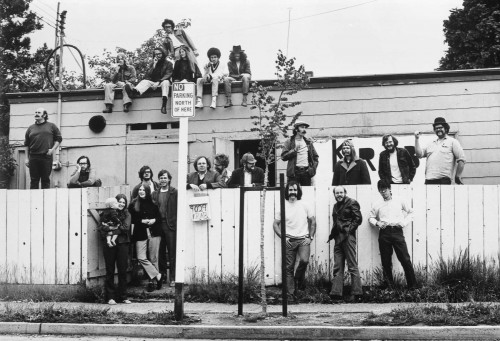
This is an old photo from the Flophouse archives.  I had completely forgotten that I had it and I looked at it for a very long time before setting it aside to be scanned.  It was taken sometime in the 1970's at the Evergreen State College radio station (KAOS) in Olympia, Washington (a small town south of Seattle).  My mother was a student there at the time and my brother and I spent a lot of time at the college while she was getting her degree.  The Evergreen State College was established in the late 60's as a an alternative, non-traditional school of higher education:  no grades and students were allowed to design their own curriculum.  One might say that a lot of the people there at the time were dragging out the 1960's as long as they could - the Pacific Northwest's very own soixante-huitards or, if you don't care for that analogy, let's just use the American term, "hippies." It was an interesting childhood - not only do I remember being allowed to read the news at the campus radio station, I also have memories of cooperatives and communes and parties where we (the child hippies) were set in a corner to amuse ourselves with a stack of The Fabulous Furry Freak Brothers comic books.

Photo from the blog DorpatSherrardLomont
In later years in Seattle, the scene was much the same.  My parents were associated with a listener-supported community radio station called KRAB.  My mother recently sent me this link to an article about the station which has a photo of some of the earliest volunteers and founders.  I recognized some of them as frequent visitors to the Thackeray Street Hotel (predecessor to the Franco-American Flophouse) and a few I knew quite well.   Tiny Freeman for one (he ran for Congress in 1972 as a Republican) and my stepfather the radio engineer who wrote a "how to" section of Lorenzo Milan's very passionate and fascinating book on listener-supported radio, Sex and Broadcasting: a Handbook for Starting a Radio Station for the Community

How to draw a line from that childhood to my decision to move to France and to stay in the Hexagon for the past 20 years?   Not obvious, is it?  Most of the time I try not to think about it too much but to be completely honest as I search my memories for my first impressions of my adopted country I find that, in addition to the joy and wonder of discovering a new culture and language, there was also a certain amount of resistance and angst on my part.   I found much to admire here but I was also put off by the sheer conservatism of the people I met in the beginning.  Even the "radicals" were, in my 20-something view, somewhat constipated and very middle-class and conventional in their worldview.  There did not seem to be much latitude given for alternative prospectives or lifestyles. And heaven forbid that a woman might defy that convention and dress comfortably (badly in their eyes) just because she wanted to and didn't care what people thought.  Like all first impressions, it turned out to be erroneous and I learned to appreciate that things were just different here and not better or worse than where I came from.

But there are still days like the other day when I came across that photo of me and my friends at the college radio station when the nostalgia breaks over me like a tidal wave and  I wonder what I might have been if I had never bought that plane ticket.  Fundamentally the same person or something radically different?  As odd as my American childhood was, it was a formative experience.  That it does not translate well is one thing - denying it is something else.  That I have often felt compelled to do so over the years is the source of some grief (even rage) and is perhaps an indication that I am not as well integrated here as I assumed.

All things to ponder as I head off to the cancer clinic this afternoon for my third round of chemotherapy.

Thursday, July 12, 2012

The Important Stuff

The weather reports are in and we all agree that this has been one of the worst summers we've seen in years here in France.  I talked to both my sister-in-law in Lille and my mother-in-law near Concarneau and everyone is reporting chilly temperatures, grey skies, and showers.

I'm from Seattle where this is not unusual and if I learned one thing from my wicked youth in the Emerald City, it's the importance of having lots of indoor projects to tide one through inclement weather. As I mentioned before I am going through my archives - these boxes of photos, old correspondence and memorabilia that we've faithfully hauled (and paid a small fortune to have hauled) from one continent to another over the past 20 years.  I've found quite a few gems in those musty old cardboard boxes.  Would you believe I still have every letter my spouse wrote to me before we were married when he was still living in Nantes and I was at university in Seattle?   This has sparked some interesting conversations with my family here as I'm not the only one to keep this sort of thing - my mother-in-law, for example, still has the very first letter I ever wrote to her in French.   I will not post any of the correspondence but there are other things like photos that I'll throw up here just for fun.

Today's offering is a quotation that I found at the bottom of the pile typed out on a yellowed piece of paper.  It came from the kitchen of a friend of mine in Seattle.  He was hands-down the worst housekeeper I've ever known.  His house was so dirty, it was almost unbearable with huge piles of old newspapers and magazines scattered about and there were cats everywhere (at least ten of them when we tried to count).  The crust alone on the kitchen floor was enough to make you queasy.  But there was one room that was more or less in order and that was the dining room.  His housekeeping might have been ghastly and unsanitary but he was one of the best cooks I've ever known.  We had some fabulous meals there and I say "we" because I met my French spouse in that house.  He was an exchange student at the time (from what is now called Centrale Nantes) and he was in town to study at the University of Washington, my alma mater. As they say, the rest is history.

My Seattle friend made no apologies for the state of his home but I'm pretty sure some of his friends spoke to him about it.  Not to criticize but because at one point it was so bad that we all wondered when the local Health department would take an interest.  Being a stubborn sort, I'm sure this did no good at all and one day when we stopped by we saw this quotation by the venerable Ed Ricketts from John Steinbeck's The Log from the Sea of Cortez set in a pretty frame and placed prominently in the kitchen.  I liked it so much that I wrote it down and kept it.  It's not a bad philosophy to live by and I might just frame it and put it up in my kitchen one of these days.  Here it is:
We must remember three things:
Number one and first in importance, we must have as much fun as we can with what we have.
Number two, we must eat as well as we can, because if we don't we won't have the health and strength to have as much fun as we might.
And number three and third in importance, we must keep the house reasonably in order, wash the dishes and such things.  But we will not let the last interfere with the other two. 
Ed Ricketts quoted by John Steinbeck in The Log from the Sea of Cortez

Sunday, July 8, 2012

Committee on Space Reseach

Last week I went poking around in my archives - those boxes of old correspondence, photos and other memorabilia that have followed us over the years as we've moved from one continent to another.  I was looking for an old family tree that was given to me before I left the States many years ago showing my ancestors (paternal line) going back to 18th/19th century Norway.   I thought it would be fun to show the Frenchlings and, given the new French style of referring to women by their maiden names (I am always "Madame Reslock" at the hospital),  the name is the object of some curiosity since "Reslock" is certainly not French, sounds vaguely European but no one I've met has been able to place it.  

Lo and behold, as I was sorting though a mass of dusty old papers, I came across a few items from the very first job that I landed in Paris over 20 years ago.  In retrospect, it was a much better job than I deserved.  At that time I was fresh out of college, had limited French and knew very little about anything of consequence - in short a typical twenty-something young woman, newly married, very wet behind the ears, on the first real adventure of her life in Paris, France.

The organization I joined was an obscure NGO called the Committee on Space Research (COSPAR) which was part of the International Council of Scientific Unions (ICSU).  COSPAR was very much a child of the Cold War.  Founded in 1958 this organization was meant to be a relatively neutral forum for space scientists from all over the world to meet, exchange results and share information about a whole host of subjects related to space research.  Its governing structure reflected the political realities of the time: there were two Vice-Presidents, one from the U.S. and one from the U.S.S.R. but the President was always elected from a third country like France or New Zealand.  My role in all of this was quite modest - I was the Assistant to the Executive Secretary, Zdislaw Niemirowicz (Dzidek), and the Secretariat was based at ICSU headquarters on the Boulevard de Montmorency in the 16th district of Paris.  Nonetheless, the job was fascinating.   I was a huge fan of science fiction (Isaac Asimov, Robert Heinlein, C.J. Cherryh) so imagine my astonishment when I met scientists who were actually studying things that I thought were purely in the realm of the wildest futuristic fantasy:  the solar wind, the geology of Mars, space biology, climate change.  Just as good were the conversations I had with my boss Dzidek, an amazing man who lived through some of the most interesting (and sanguinary) events of 20th century Europe:  World War II, the Warsaw uprising, and life behind the Iron Curtain in Poland before he was able to relocate to France with his family.  There was even some travel involved since COSPAR held a conference every two years in some very interesting locales.

After a few years we once again decided that the grass was greener on the other side of the Atlantic and we moved on.  But I still have some great memories of my time at COSPAR and I try to keep up with space exploration projects going on in Europe and other places.  There is a lot more going on than one would imagine from reading the newspapers, watching the news and trolling the Internet.  Space just isn't big news these days and perhaps that is understandable given the various crises that have people afraid for their jobs and governments agonizing over their national budgets.  Still, it's sad that we have so little time or inclination these days to dream of the final frontier.  And it's a bit short-sighted since our ultimate survival as a species may in fact depend on our getting off this damn rock one day.  As Robert Heinlein once said, "The Earth is just too small and fragile a basket for the human race to keep all its eggs in."

Happily there are still scientist and engineers quietly working on it and making progress.  Here is what ESA (European Space Agency) has on the agenda for 2012.


That is what is as we start the second decade of the 21st century.  For one of the best reads about what could be, check out one of my all-time favorite science fiction novels, Downbelow Station by C.J. Cherryh.

Bon dimanche à tous!