It's Golden Week in Japan and we are getting out of town
The Flophouse is spending this vacation-filled week in Thailand - a place we always wanted to visit but didn't the last time we lived in Japan.
We fly into Bangkok on a China Eastern Airlines flight, spend two days and nights in the city and then we get in a car and head for the countryside. We have signed up for a guided tour with a very enticing program: national parks, floating markets, temples, tigers, and the bridge over the River Kwai.
Yes, I saw the movie. More than once. I will take pictures of the railway and share them with you when we get back.
In the meantime, you might enjoy this documentary about the war, the building of the railway - the tracks, the trestles and bridges - and the lives that were lost.
Thursday, April 30, 2015


Wednesday, April 29, 2015
The Hill: Tax Justice for Americans Abroad
In response to those articles touting FATCA as "Tax Justice", the incomparable Lynne Swanson of Maple Sandbox and I wrote an op-ed that has just been published in The Hill's Congress Blog.
Tormented Americans Abroad Need Tax Justice Too
If you have been following the fight against FATCA and CBT at the Isaac Brock Society, on Facebook or here at the Flophouse, the arguments in our article will not be new to you. But we need to keep making them in as many places as we can - especially in Washington, D.C. - so that our side of the matter is heard loud and clear.
Please add your thoughts by commenting on the article. And please pass the link along to other Americans abroad who might be interested in reading and commenting as well.
We may live abroad but we are just as much the "American People" as any homelander. 7 million strong, we are larger than many US states. Time to assert and use what is rightfully ours: a voice.
Tormented Americans Abroad Need Tax Justice Too
If you have been following the fight against FATCA and CBT at the Isaac Brock Society, on Facebook or here at the Flophouse, the arguments in our article will not be new to you. But we need to keep making them in as many places as we can - especially in Washington, D.C. - so that our side of the matter is heard loud and clear.
Please add your thoughts by commenting on the article. And please pass the link along to other Americans abroad who might be interested in reading and commenting as well.
We may live abroad but we are just as much the "American People" as any homelander. 7 million strong, we are larger than many US states. Time to assert and use what is rightfully ours: a voice.
Tuesday, April 28, 2015
Another Glorious Day at Minoo Park
Apart from my personal (un)dress fiasco, Sunday was another wonderful day at what I think is Osaka's most beautiful park.
Last time I was there it was the middle of winter and I still enjoyed every minute of it. With better weather, it was a nearly perfect experience.
The trail is about 2.5 kilometers with a gentle gradient going up to the waterfall and in summer 90% of it is under the trees and in the shade. There is something on the trail for everyone: the culture vultures can admire the temples and shrines, the foodies can eat at one of the many restaurants and cafes, and the nature lovers can concentrate on the stunning scenery and malicious monkeys. Just a little downstream from the waterfall, the river is calm and shallow and there were children happily splashing around in the water and climbing over the rocks under the eyes of their parents and grandparents.
Minoo Park is a perfect outing for families, couples, lovers, seniors - it's a park that is accessible to - and has something for - just about everyone. (And it's free.)
So, if any of you folks ever show up to visit the Flophouse here in Osaka, guess where we will be going? A trip to this park is not optional; it's required of all guests. I hope that expresses just how much I love it and want to share it with visitors.
Here are a few pictures from Sunday. Enjoy.


Last time I was there it was the middle of winter and I still enjoyed every minute of it. With better weather, it was a nearly perfect experience.
The trail is about 2.5 kilometers with a gentle gradient going up to the waterfall and in summer 90% of it is under the trees and in the shade. There is something on the trail for everyone: the culture vultures can admire the temples and shrines, the foodies can eat at one of the many restaurants and cafes, and the nature lovers can concentrate on the stunning scenery and malicious monkeys. Just a little downstream from the waterfall, the river is calm and shallow and there were children happily splashing around in the water and climbing over the rocks under the eyes of their parents and grandparents.
Minoo Park is a perfect outing for families, couples, lovers, seniors - it's a park that is accessible to - and has something for - just about everyone. (And it's free.)
So, if any of you folks ever show up to visit the Flophouse here in Osaka, guess where we will be going? A trip to this park is not optional; it's required of all guests. I hope that expresses just how much I love it and want to share it with visitors.
Here are a few pictures from Sunday. Enjoy.
Monday, April 27, 2015
Dress Codes
We went back to Minoo Park north of Osaka this weekend and walked the trail up to the waterfall and back. It was a beautiful 25 degree day and not too humid. Still, halfway up the hill I bought a bottle of Evian water and took off my jean jacket. My pale Norwegian skin started soaking up the sun and I could feel a slight breeze around my sweaty neck. My shoulders were bare and the straps of my tank top were so thin they couldn't hide the green and indigo bluebell tattoo on the left side.
It was such a relief to be relieved of the extra clothing that it took me a few minutes to realize that I was the only person on that trail showing that much skin.
Most of the women wore shirts with sleeves covering their elbows, which looked both uncomfortable and poorly adapted to the heat. A few (very few) women wore t-shirts with sleeves. All of us wore jeans, pants or skirts that covered our knees.
Culture is more implicit than explicit. It's not so much about what people say - the should's and ought to's - it about what people do. There was a cultural dress code on that slope and I was in violation of it. Not that anyone said anything - they didn't need to. It was all in the looks and the looking away.
Now at this point a woman like me, forged in the fires of Western individualism tempered by feminism, and provoked by the feeling of discomfort that comes when one senses judgement, lets her mind off its leash. The first feeling is defiance and the first thought is: I can wear whatever I damn well want.
And that simply isn't true. Wherever I have lived or travelled there are dress codes for men and women. Even countries that are fairly liberal about appropriate attire have some hard limits. A Frenchman in Paris doesn't wear a thong to work at the bank and an American in Seattle doesn't wear a miniskirt to a corporate job interview. A woman can go topless on vacation on the beach in Brittany, but she's expected to have something covering the area below her navel and above her upper thighs.
In France, Canada and other Western countries there are actually moves to ban certain forms of dress for women. This is societal disapproval so strong that they want to make explicit rules and laws with the means to punish people for their deviant dress, and that says that citizens no longer trust their own cultural forces to do this important work for them.
So the reality is that I don't get to wear whatever I want, wherever I am, unless I am willing to accept the consequences. It is not really about the Japanese dress code for women - it is about my trying to import a French dress code to Japan, and then masking the attempt under appeals to Western individualism and feminist principles. What I damn well want is to not change, and I resent the new cultural forces around me that are ever so gently trying to nudge me in that direction.
There is a great question that one can use to get though these moments of angst and anger when swimming in new cultural seas: Do I want to be defiant and angry, or do I want to be happy?
That's easy to answer: I want to be happy.
Time to go shopping....
It was such a relief to be relieved of the extra clothing that it took me a few minutes to realize that I was the only person on that trail showing that much skin.
Most of the women wore shirts with sleeves covering their elbows, which looked both uncomfortable and poorly adapted to the heat. A few (very few) women wore t-shirts with sleeves. All of us wore jeans, pants or skirts that covered our knees.
Culture is more implicit than explicit. It's not so much about what people say - the should's and ought to's - it about what people do. There was a cultural dress code on that slope and I was in violation of it. Not that anyone said anything - they didn't need to. It was all in the looks and the looking away.
Now at this point a woman like me, forged in the fires of Western individualism tempered by feminism, and provoked by the feeling of discomfort that comes when one senses judgement, lets her mind off its leash. The first feeling is defiance and the first thought is: I can wear whatever I damn well want.
And that simply isn't true. Wherever I have lived or travelled there are dress codes for men and women. Even countries that are fairly liberal about appropriate attire have some hard limits. A Frenchman in Paris doesn't wear a thong to work at the bank and an American in Seattle doesn't wear a miniskirt to a corporate job interview. A woman can go topless on vacation on the beach in Brittany, but she's expected to have something covering the area below her navel and above her upper thighs.
In France, Canada and other Western countries there are actually moves to ban certain forms of dress for women. This is societal disapproval so strong that they want to make explicit rules and laws with the means to punish people for their deviant dress, and that says that citizens no longer trust their own cultural forces to do this important work for them.
So the reality is that I don't get to wear whatever I want, wherever I am, unless I am willing to accept the consequences. It is not really about the Japanese dress code for women - it is about my trying to import a French dress code to Japan, and then masking the attempt under appeals to Western individualism and feminist principles. What I damn well want is to not change, and I resent the new cultural forces around me that are ever so gently trying to nudge me in that direction.
There is a great question that one can use to get though these moments of angst and anger when swimming in new cultural seas: Do I want to be defiant and angry, or do I want to be happy?
That's easy to answer: I want to be happy.
Time to go shopping....
Sunday, April 26, 2015
Rivers of Experience
"Nothing has changed, but it feels so strange. I can't quite put my finger on it. Everything looks the same, but it feels different."
Chris Brinlee, Jr.
That is exactly what I was feeling last week about Tokyo. Everything about it was familiar - the shops, the streets, the subway - and at the same time everything was off.
Because Tokyo had changed in eight years and so had I. When I left Japan nearly a decade ago I pulled myself out of one moving river and dived into another halfway across the world. And while I was gone the city and the people I knew moved on and became a different city and different people.
Chris Brinlee, Jr.
That is exactly what I was feeling last week about Tokyo. Everything about it was familiar - the shops, the streets, the subway - and at the same time everything was off.
Because Tokyo had changed in eight years and so had I. When I left Japan nearly a decade ago I pulled myself out of one moving river and dived into another halfway across the world. And while I was gone the city and the people I knew moved on and became a different city and different people.
And part of me was not happy about it. At all.
This is not the first time I've felt this eerie combination of familiar mixed with strange. Returning to Seattle a few years after I had moved to France, I flew in from Paris to the local airport and my brother drove me into town. When I saw that they had torn down a large sports stadium that had been a prominent part of the city skyline since I was a small child, I was filled with such rage. "How dare they do that," I thought, as though Seattle were a part of my personal patrimoine and the denizens needed my permission before they so much as clipped a hedge or painted a wall. Even now, as irrational as it sounds, I deeply resent any changes to my hometown.
But life is a moving river of experience and the harder you try to make things stand still, the more they slip through your fingers. The moment you trap the water in your mind, it ceases to be the real river and becomes still water in a plastic jug.
Nothing that lives and breathes is static, not even our own insignificant precious little selves. Not only do we live in moving rivers, but the "I" itself is one. Next time I head for Tokyo, I resolve to accept it as the city it is in 2015, and not resent it for ceasing to be the city it was in 2007. And I will try to accept as well that I am not the person I was eight years ago.
Clearly, I need the practice because while I am dipping my toes in the waters of another dynamic city, Osaka, another place - the city of Versailles where I have my home and my beloved garden - is moving merrily along without me. And when we return in a few years, the things and people I knew will be as off to me then as Tokyo was just last week.
This is not the first time I've felt this eerie combination of familiar mixed with strange. Returning to Seattle a few years after I had moved to France, I flew in from Paris to the local airport and my brother drove me into town. When I saw that they had torn down a large sports stadium that had been a prominent part of the city skyline since I was a small child, I was filled with such rage. "How dare they do that," I thought, as though Seattle were a part of my personal patrimoine and the denizens needed my permission before they so much as clipped a hedge or painted a wall. Even now, as irrational as it sounds, I deeply resent any changes to my hometown.
But life is a moving river of experience and the harder you try to make things stand still, the more they slip through your fingers. The moment you trap the water in your mind, it ceases to be the real river and becomes still water in a plastic jug.
Nothing that lives and breathes is static, not even our own insignificant precious little selves. Not only do we live in moving rivers, but the "I" itself is one. Next time I head for Tokyo, I resolve to accept it as the city it is in 2015, and not resent it for ceasing to be the city it was in 2007. And I will try to accept as well that I am not the person I was eight years ago.
Clearly, I need the practice because while I am dipping my toes in the waters of another dynamic city, Osaka, another place - the city of Versailles where I have my home and my beloved garden - is moving merrily along without me. And when we return in a few years, the things and people I knew will be as off to me then as Tokyo was just last week.
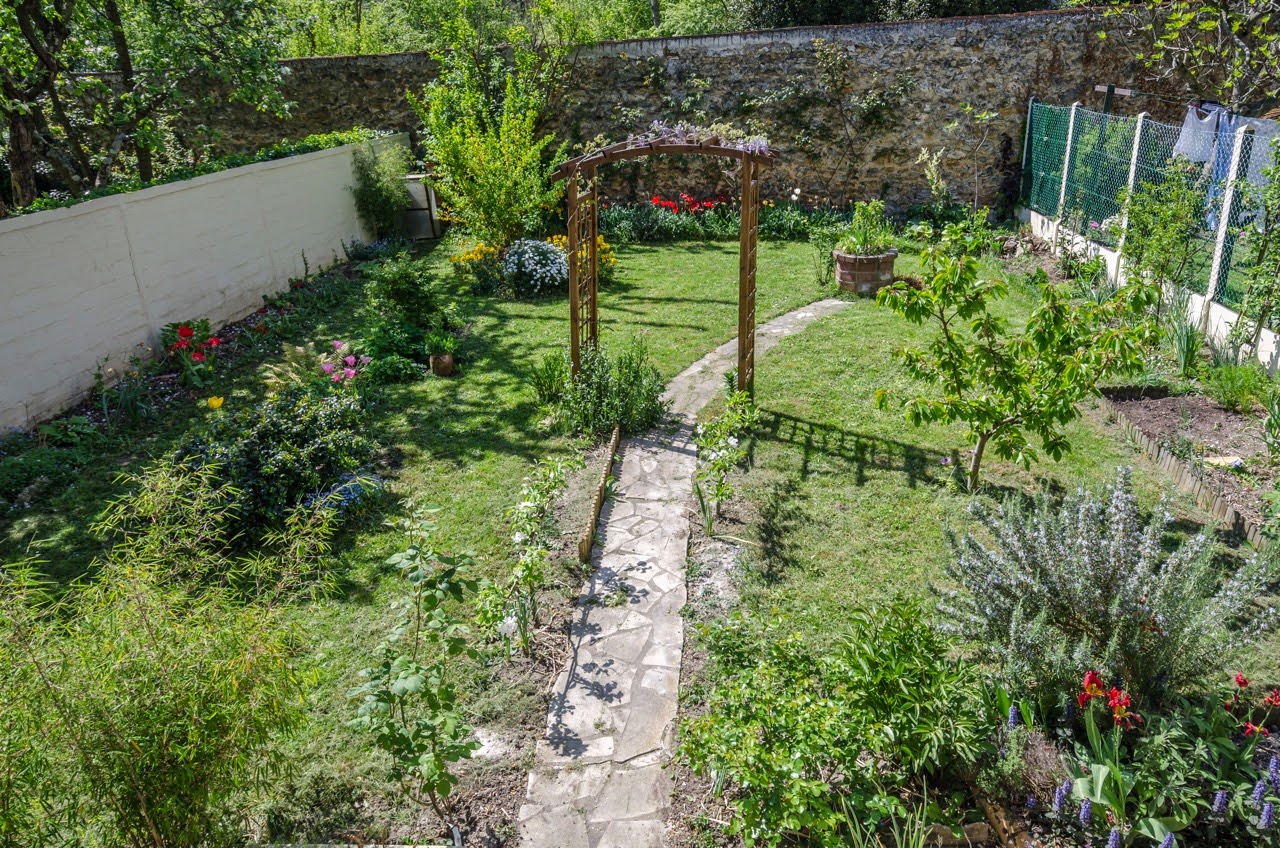 |
| Flophouse Garden, Versailles, France. April 2015 Photo by Michael Staubes |
Tuesday, April 21, 2015
Trotting Off to Tokyo
Tomorrow, I am hopping on a shinkansen and heading for Tokyo - one of my favorite cities.
I will be there for a few days and staying in the Ginza area.
So if there are any Flophouse readers who would like to get together Thursday or Friday, just let me know at v_ferauge@yahoo.com.
I will be there for a few days and staying in the Ginza area.
So if there are any Flophouse readers who would like to get together Thursday or Friday, just let me know at v_ferauge@yahoo.com.
Doing Something about FATCA: Same Country Exception, Repeal, and Legal Action
Stephen Mopsick has reposted an article by Charles Bruce of American Citizens Abroad (ACA) proposing that the US "Treasury Department should promulgate rules permitting individuals to elect, if they wish, to have their local financial accounts, in effect, exempted from FATCA."
This proposal is not new and is known under different names: "Same Country Exception" or "Safe Harbour Exemption." Here is what the different Americans abroad organizations have to say about it:
American Citizens Abroad
This proposal is not new and is known under different names: "Same Country Exception" or "Safe Harbour Exemption." Here is what the different Americans abroad organizations have to say about it:
American Citizens Abroad
"ACA, Inc. proposes a FATCA Same-Country Exception for accounts of US taxpayers resident abroad. If implemented, this would help alleviate the problem of financial services lock-out currently being experienced by Americans resident overseas. In a letter to the Treasury Department (Oct. 2013), ACA, Inc. has asked that this rule be applied for bank accounts held by American citizens in their country of residence."Association of Americans Resident Overseas-Federation of American Women's Clubs Overseas
"Short of repeal, the same country exception, also called “safe harbor” in Washington, has been AARO’s position concerning FATCA. The idea is that we are bona fide residents of another country than the US and the accounts in that country are our domestic accounts. We would like the US to consider them as domestic accounts and not foreign accounts. To do this would require regulatory change in Washington, which, given the frigid relationship alluded to before, will not happen without congressional mandate. It would also require the banks where we live to agree to it.Democrats Abroad:
"When a safe harbor exemption is applied to FATCA, the law would treat the financial accounts of Americans abroad in their country of residence the same way as it treats the US accounts of Americans residing in the US. In brief, foreign financial institutions would be exempt from filing FATCA reports on the accounts of US-tax compliant Americans residing legally in the same country. A FATCA safe harbor exemption would only exempt accounts held in the country in which the account holder is legally resident."
All of the Americans abroad organizations (with one exception) support it as the solution most likely to be accepted and implemented by the US government. As much as Americans abroad would like to see FATCA disappear, these organizations argue that this is not realistic and that FATCA won't be going away any time soon. That is the consensus and, separately or together, all of them have lobbied Washington for several years now in support of this idea.
There is one organization that is taking a different stance and that is Republicans Overseas. They want to repeal FATCA and the Republican National Committee passed a resolution in 2014 to that effect.
"RESOLVED, The Republican National Committee hereby presents this Resolution to each Member of Congress and urges the U.S. Congress to repeal FATCA, to defend the livelihood and increase the competitiveness of Americans overseas, to remove inappropriate invasions of Americans citizens’ privacy, and to allow those U.S. citizens who renounced their citizenship due to FATCA to regain their U.S. citizenship..."
The Republicans have also launched a lawsuit - FATCA Legal Action - against FATCA (Flophouse post here). They say that FATCA is not only detrimental to Americans abroad but it also violates their consitutional rights.
US citizens living outside the United States, these are the proposals, actions, initiatives on the table right now. This is what these organizations are asking (or fighting) the US government for on your behalf and in your name - "We represent the interests of the 7 million Americans abroad...." That means YOU and YOUR interests.
I urge you to take a few minutes to follow the links above with an open mind - please don't let preconceived notions about "women's clubs", "Republicans', or "Democrats" get in the way.
Read each organization's proposal carefully so that you understand what they mean by "Same Country Exception", "Safe Harbor", "Repeal FATCA" and "FATCA Legal Action". If there is something you don't understand, ask. If there is something you don't agree with, say so.
And once you have done your due diligence and made up your mind, there is one last question to ask:
What can I do to help?
Subscribe to:
Posts (Atom)